Acquiring users efficiently and building the systems that keep them.
Four years running acquisition, launches, and retention across gaming, proptech, media, and entertainment.
About my work
What I do
My work sits across user acquisition, product positioning and retention. I shape go-to-market strategy, run paid social and creator campaigns, and build the lifecycle flows that keep users active.
Over the last four years, I’ve worked across gaming, proptech, media and entertainment with teams like fan iq, Hochela and Omo Studios.
I run campaigns, fix underlying mechanics, and do everything in between, whether that’s lowering CAC on an established channel or building a regional expansion playbook from scratch.
Career stats
Season Record
The numbers from every season played so far.
4+ yrs
Building growth systems across gaming, proptech, media, and entertainment
2,100+
Users gained in 8 months
₦5.1M+
Gross wager volume from real-money gameplay
18.5%
Wager conversion rate, converting top-of-funnel users into real-money players
₦506
Blended CAC achieved on an 879-user, 11-creator, one-month acquisition sprint
₦2M
Co-marketing funding secured through strategic brand partnerships for flagship activations
1,877
Players acquired through self-initiated product features that became the primary acquisition driver
6,700+
Wager entries from 389 core users — averaging 17 wagers each
100+
Creative assets produced, including 60 short-form/animations, 10 long-form videos, and 30+ scalable design templates
15%
Landing page conversion, driving 745 student registrations from 5,000+ site visits
Worked with
Brands & Organisations
Selected work
Case Studies
Where culture-led acquisition meets conversion-focused growth. Explore how I turn first-time visitors into engaged, revenue-generating users.
Growing up, I loved playing games, mostly Super Mario Bros. with my family. That’s where my curiosity about why people love the things they do, and how great products leave a lasting impression, really started. And it’s never gone away.
I started out as a creative, and at my core, I still am. I channeled that into freelancing first, and later into DFRNT.ENT, curating experiences and building a space where young people could come together and just be themselves. I had to figure out what made people care, what made an experience worthwhile, and what made them actually pay for it. Those lessons have grown into a drive to be part of a team creating something valuable for people everywhere.
I see marketing like a football team sheet: different players, each with a role to play, and I build campaigns the way a manager builds tactics.
Outside my work
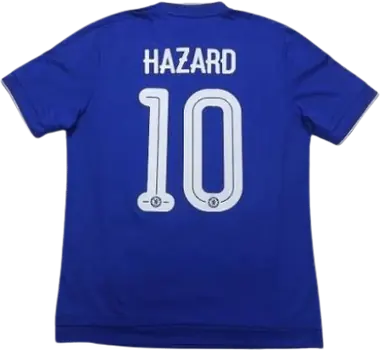
If I’m not working, you’ll probably find me on Football Manager. My best save is still winning the Champions League with Crystal Palace on FM24. In real life, I’m a Chelsea fan and I love analyzing football games.
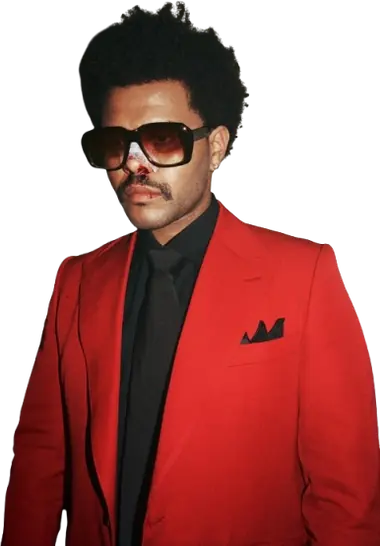
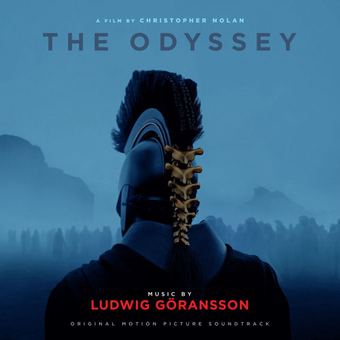
I’m a sucker for great music production. I listen to a lot of The Weeknd, Brent Faiyaz, and Frank Sinatra Jr., and right now I’m obsessed with Ludwig Göransson’s score for The Odyssey. I also keep rewatching Spider-Man: Into the Spider-Verse, and I love animated series like Neon Genesis Evangelion and Family Guy (Seth MacFarlane is a genius).
I speak English and a bit of French (just enough to get by), and a day doesn’t go by without a bottle of Pepsi.
Building an event-driven growth engine, with a creator playbook behind it, from a 200-user beta to 2,100+ registered users and ₦5.1M in wager volume.
RoleGrowth & Product Marketing Lead
TypeConsumer Gaming · Real-Money Trivia · Web App (PWA)
Companyfan iq
ScopeGTM Strategy · User Acquisition · Influencer Marketing · Community Building · Performance Tracking
Status2025 – 2026
AT A GLANCE
2,105Registered users, up from a beta of about 200
1,877Challenge players across 14 challenges
₦506Blended CAC across a 3-week, 879-user creator sprint
₦5.1MWager volume across 6,701 entries
The Challenge: Growing Past Beta
fan iq had developed a high-fidelity Progressive Web App (PWA) built around a fast-paced football trivia mechanic: two players wager money, answer five questions under a time limit, and earn points for accuracy and speed. The core positioning was locked — reward fans for their football knowledge rather than leaving it to the chance of a betting parlay.
However, the platform was bottlenecked. We had a seed community of roughly 200 beta testers, but the business needed a Go-To-Market strategy capable of driving mass acquisition without relying entirely on highly volatile, expensive paid ad spend. I needed a way to keep bringing in football fans without paying for every signup, and to get them to actually wager.
The Strategy: Research First, Then a 3-Phase Growth Engine
Groundwork: ICP, Research and Positioning
Before any campaign, I did the preparation. I defined two audiences. The core ideal customer was the football fan who already gambles on matches: someone already willing to put money behind what they believe about football. The second was the casual fan: someone who does not always gamble on football, but is engrossed enough in the game to use the free version of the product and, over time, move to paid wagers and multiplayer matches.
I then reached out to football fans directly to understand how they interact with football trivia, what frustrated them about gambling, and how fan iq could solve those problems. I also mapped where they spend their time online, which turned out to be betting groups on Telegram and WhatsApp, and that decided where we showed up first.
The research shaped the message as well as the channel. fan iq was positioned as the alternative to chance-based gaming: a place that rewards fans for their football knowledge, rather than leaving it to the chance of a betting parlay.
Phase 1: Seed Community & The "Skill vs. Chance" Wedge
We seeded the initial beta through organic outreach on X, waitlists, and niche football communities. To drive early adoption, I took that anti-parlay positioning into every channel, presenting fan iq not as a casual game, but as an arena to monetize football IQ.
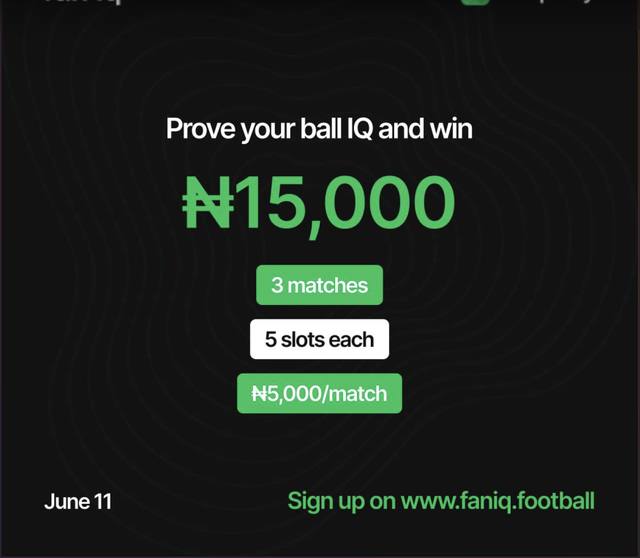
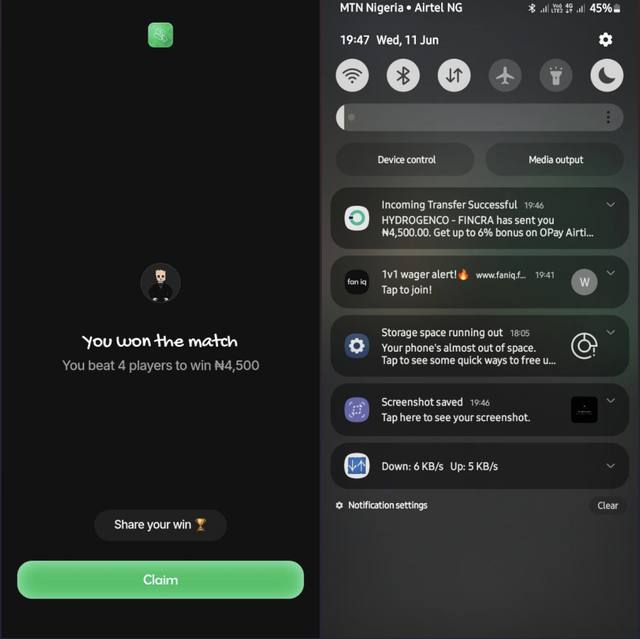
To keep this baseline community engaged on Telegram, I ran a 5-day referral program, established a steady cadence of football content, and beta-tested "Group Play" — a new multiplayer feature allowing more than two users to compete in a single session. We leveraged this mode to host community giveaways, funding real monetary rewards for the winners to drive early installs. This sprint spiked our community participation by 50%.
First Group Play match, June 2025: ₦5,000, 5 slots.Winner screen: ₦4,500 payout.
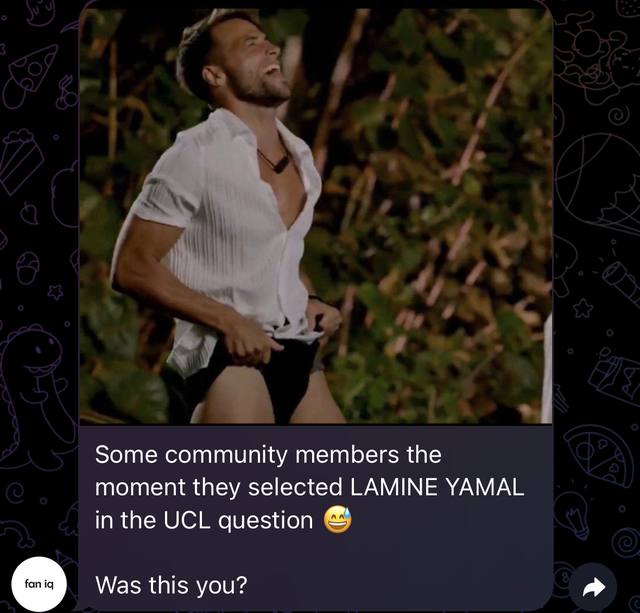
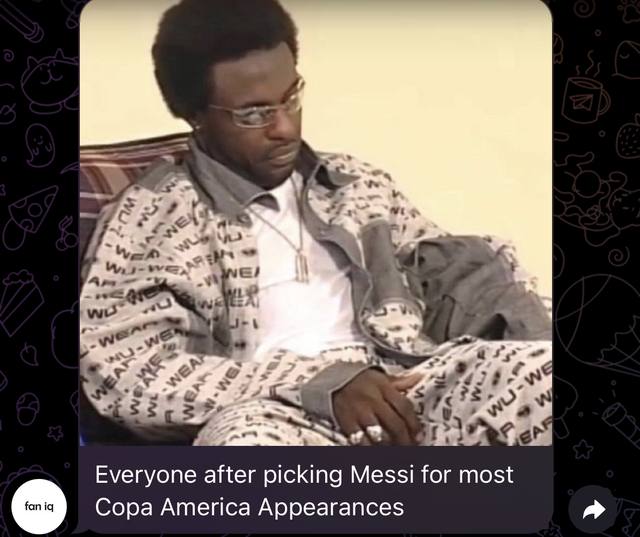
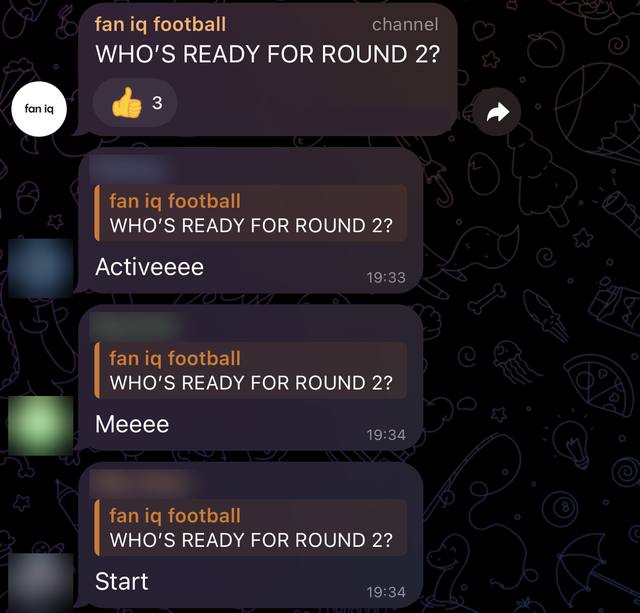
Keeping the room warm
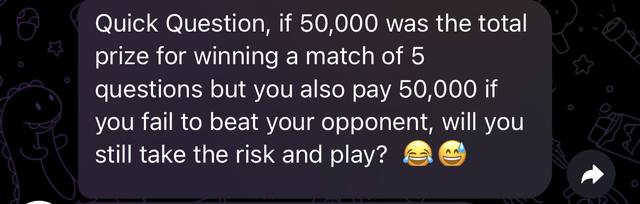
Banter after a UCL question.Banter on the Copa América question.“Who’s ready for round 2?”A prompt on risk and prize size.
Community Telegram channel, June 2025. Names removed.
Phase 2: Grassroots Validation & The "Challenge" Engine
To scale beyond the seed users, we built a new acquisition engine: Challenges. These were free-to-play, weekly club or competition-themed events, piloted over 7 days and later standardised to 5 daily sections, where fans competed on a live leaderboard for real rewards (jerseys, cash, gift cards).
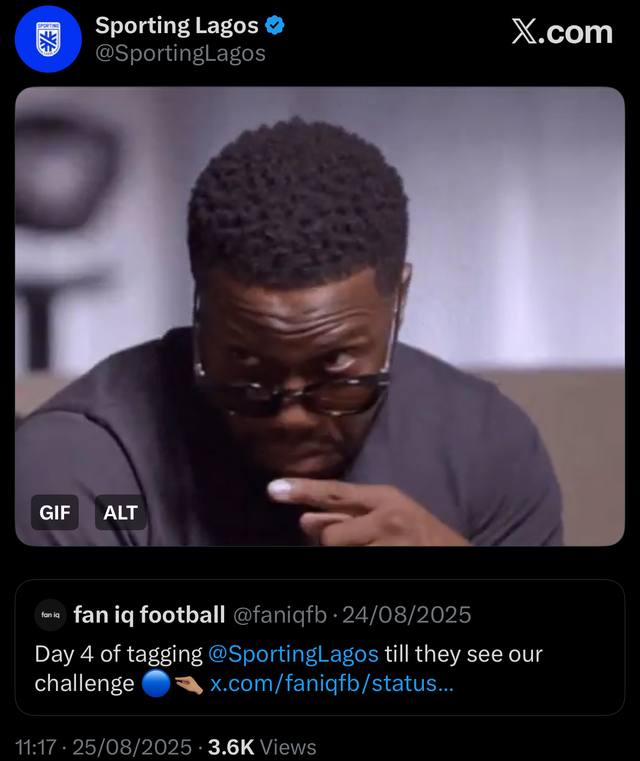
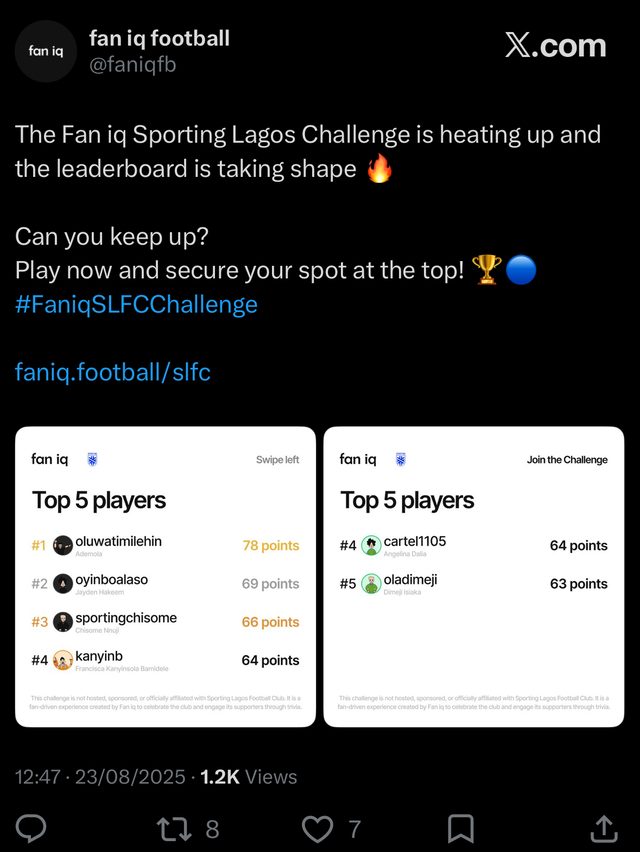
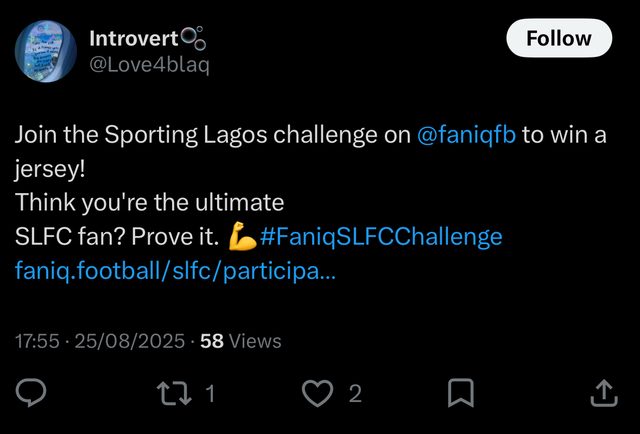
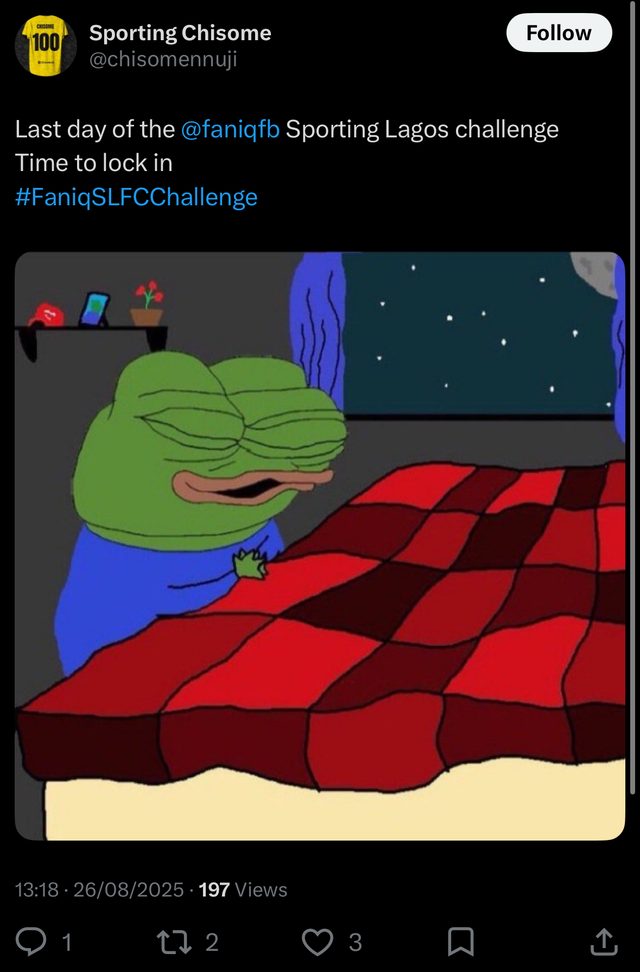
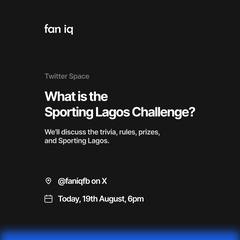
Before deploying significant budget, I tested this 0-to-1 engine during the Nigerian National League (NNL) off-season. We launched a 7-day challenge themed around Sporting Lagos, dynamically changing our app and social media colorways to match the club's brand identity. To market it and seed our first early adopters beyond the beta users, I partnered directly with the moderators of the "Sporting Fan Zone" WhatsApp group, a fan community for the club. I incentivized referrals by awarding players points for sharing the link. The UGC loop caught wind and fans flooded X with the #FaniqSLFCChallenge hashtag, ultimately resulting in an official endorsement and retweet from the Sporting Lagos X account.
Sporting Lagos replies, 25 Aug 2025 (3.6K views).
Our leaderboard update, 23 Aug 2025 (1.2K views).Organic fan post, 25 Aug 2025.Last day, 26 Aug 2025: a fan says lock in.
#FaniqSLFCChallenge on X, 23–26 Aug 2025.
Phase 3: Event-Driven Virality & The Creator Playbook
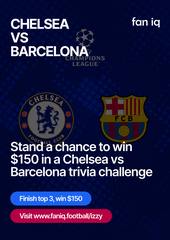
With the mechanics validated locally, I scaled the challenge engine into a mass-acquisition vehicle. Challenge campaigns were mapped across various footballing events such as AFCON and the World Cup, high-stakes fixtures like the Manchester Derby and Chelsea vs. Barcelona, and a diverse range of individual clubs and national teams to maximize our Total Addressable Market (TAM).
To drive traffic and power these campaigns, I wrote a creator brief for each group of X creators, picked by audience, club allegiance, engagement and niche, to stretch the budget and lower CAC. Instead of paying for generic shoutouts, I asked them to post the way they already argue on the timeline:
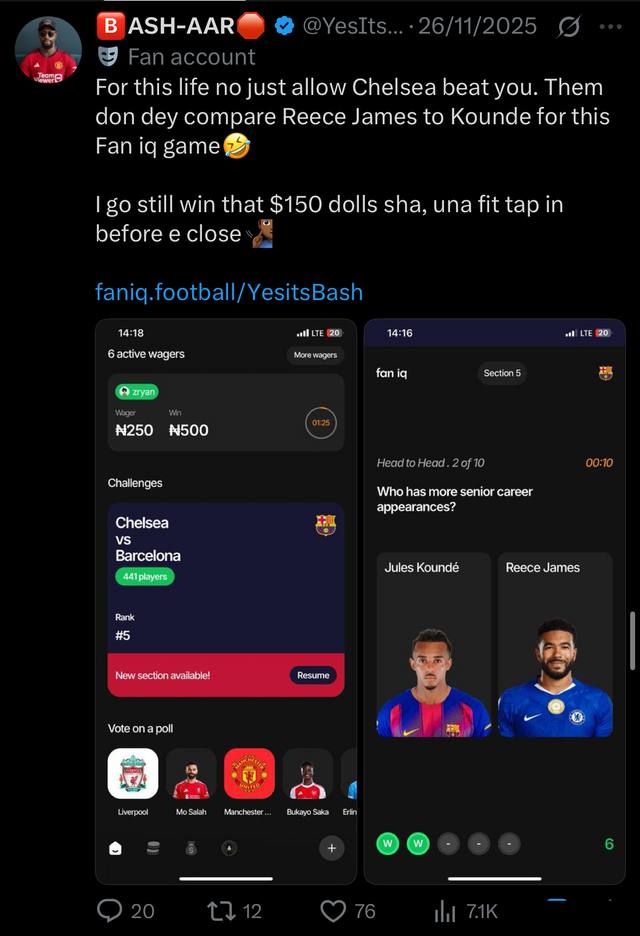
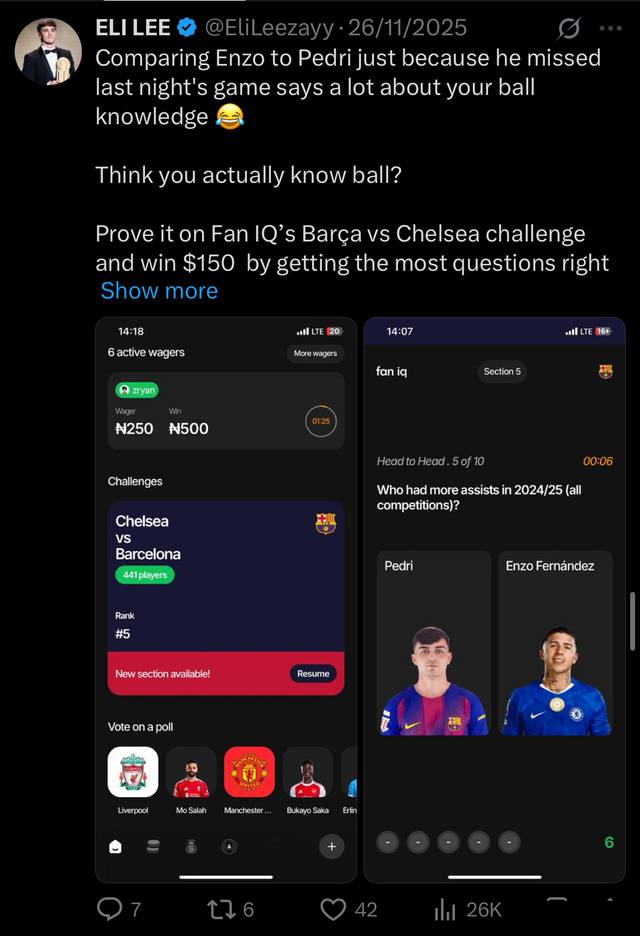
Manufactured Rage-Bait: Creators posted polarizing player comparisons (e.g., Chelsea's Reece James vs. Barcelona's Jules Kounde) directly tied to our in-game questions, forcing rival fans into the replies.
The "Skill vs. Chance" Pitch: Creators framed the app natively in street language, challenging followers to stop wasting their football knowledge and start monetizing it.
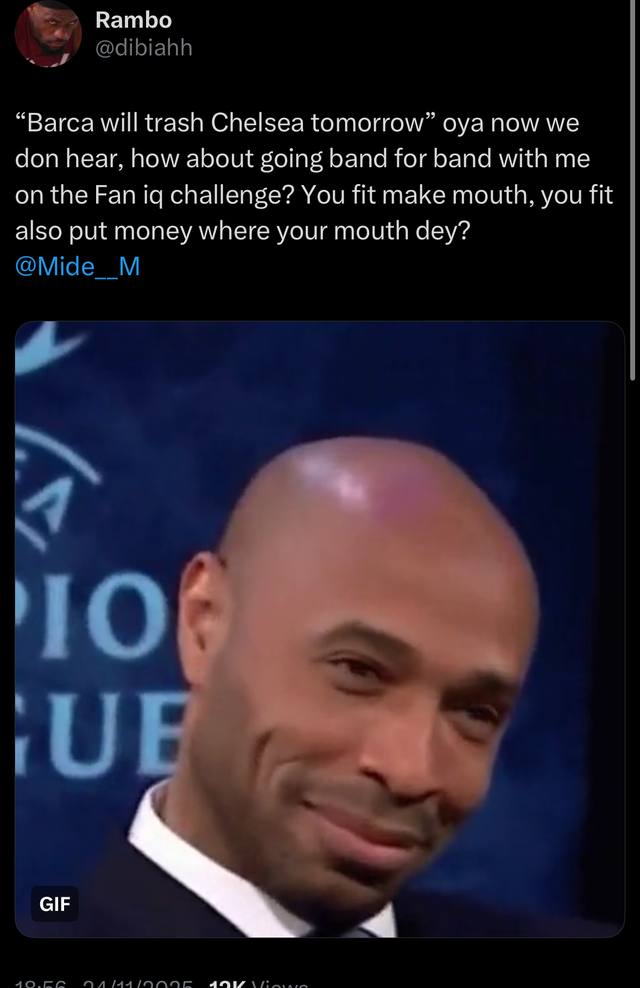
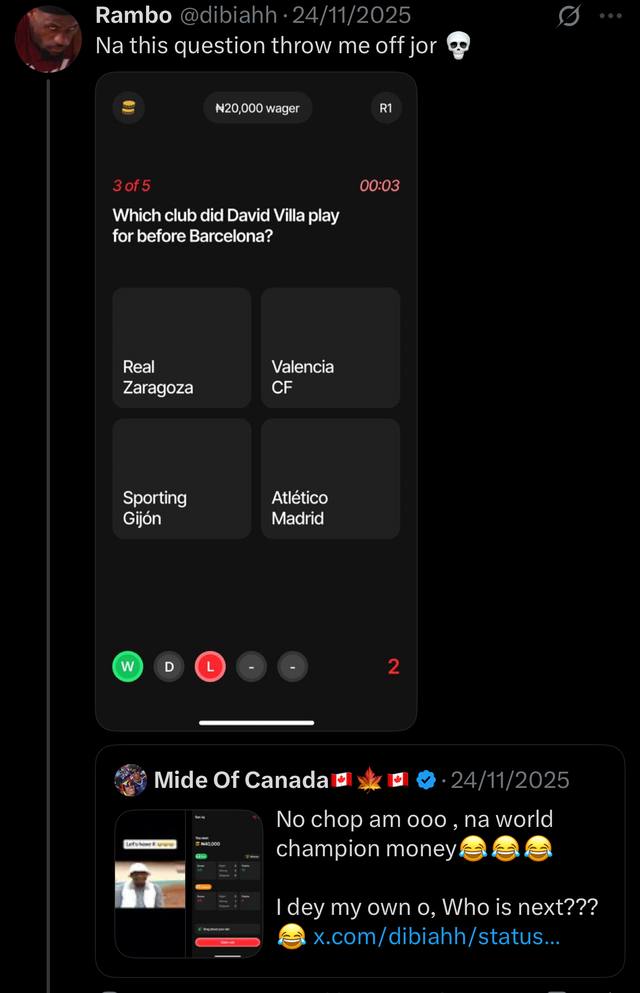
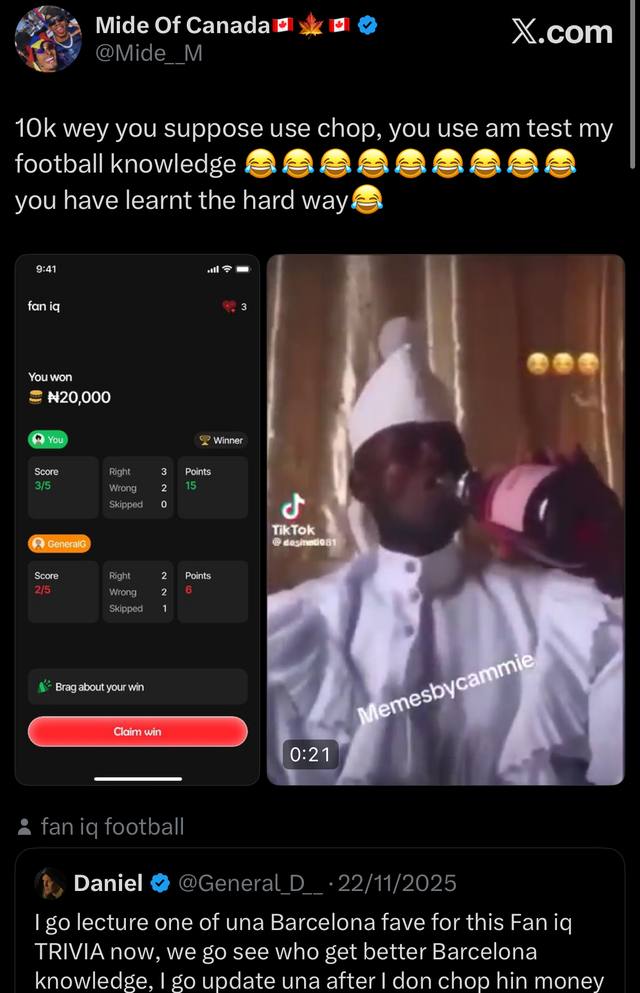
"Band for Band" Wagers: Creators aggressively challenged their followers to back up their football opinions with real money, seamlessly pushing users from the free challenge into paid 1v1 arenas.
Manufactured rage-bait
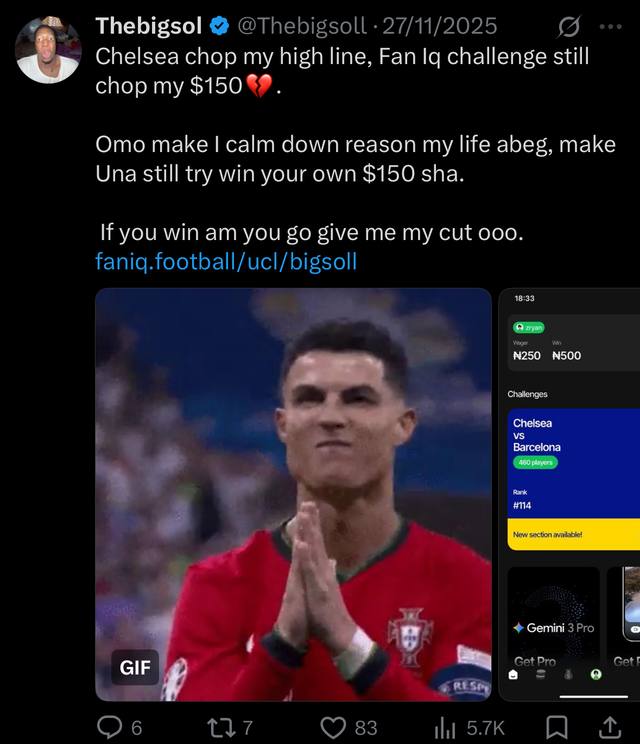
Reece James vs. Kounde (7.1K views).Enzo vs. Pedri (26K views).Loss as content.
Band for band
The call-out (12K views).The follow-up: a ₦20,000 wager.The receipt: a ₦20,000 win.
The Impact: Real-Time Conversion at Scale
The challenge format worked as a repeatable way to bring in players, and took fan iq from beta to a live product.
Pilot result: The Sporting Lagos pilot acquired 112 users, with 40 returning for subsequent games — proving early product-market fit.
Volume: The engine generated 1,877 total challenge players across 14 challenges (full ranking below), taking registered users from a ~200-user beta to 2,100+ across all channels.
Converting in the moment: Our Chelsea vs. Barcelona peak pulled in 432 players. Crucially, 95% of the users in the analysis joined after the challenge went live, showing the creator playbook turned real-time match hype into instant product registrations.
How the timeline reacted
It spread beyond the timeline
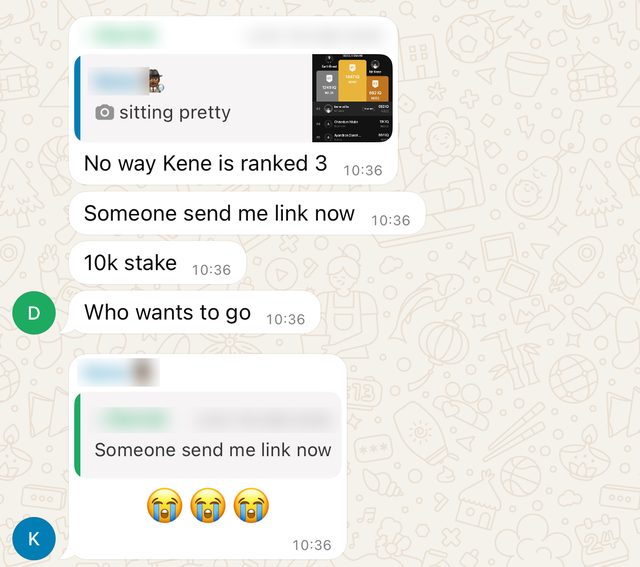
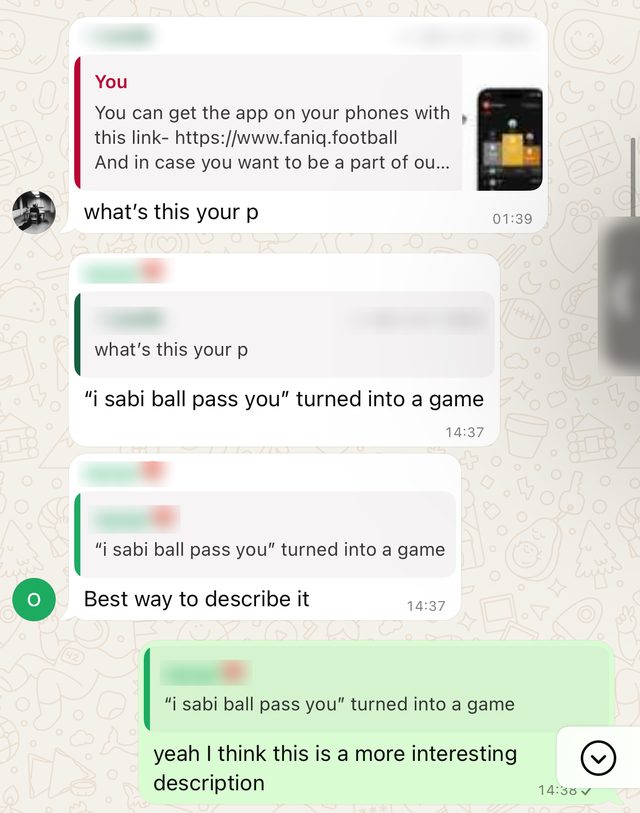
A leaderboard screenshot, then requests for the link.“i sabi ball pass you” became a game, unprompted.
WhatsApp groups. Names and numbers blurred.
After Chelsea vs. Barcelona: More Challenges, a Creator Activation for Each
The Chelsea vs. Barcelona challenge worked, so I started running them as often as possible. Each challenge was mapped to a club or fixture, and each one got its own creator activation: a roster matched to that audience, a brief built around the challenge’s hook, and a tracked link per creator. The 14 challenges in the dataset ran from Chelsea vs. Barcelona on 22 Nov 2025 to The Reds on 20 Apr 2026, and brought in 1,877 players.
Players by challenge, all 14 challenges (Nov 2025 – Apr 2026)
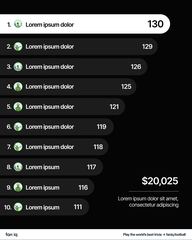
Chelsea vs. BarcelonaNov 2025432
Real Madrid CFDec 2025302
Man Utd FCApr 2026250
The RedsApr 2026199
The Gunners (Dec)Dec 2025181
Man City FC116
Premier League 25/2677
Lionel Messi68
UCL Knockouts62
AFCON 202543
The Gunners (Apr)Apr 202643
Chelsea FC40
Proper Barclays36
Carabao Cup28
The top three (in red) drew 52.4% of all players, and the top five 72.7%.
The biggest spikes were the weeks with the heaviest campaign behind them, and the live event did the converting: 411 of Chelsea vs. Barcelona’s 432 players joined after it had already started.
The Creator Engine: Run Like a Performance Channel
Each of those activations had to be accountable. fan iq needed an influencer engine that could acquire volume and do it efficiently, not a run of one-off posts. I owned it end to end: sourcing and negotiating with each creator, the roster, the briefs, budget allocation and performance tracking. In total, from November 2025 to April 2026, that was 24 creators and roughly ₦3M in spend.
From November to about March, across all campaigns, CAC averaged about ₦1,046 per acquired user. It then came down to ₦442 and ₦416 in the first two April campaigns, as I wrote better-defined briefs, moved to result-led phrasing and brought in better-fit creators, before climbing again.
Blended CAC over time (₦ per acquired user)
Nov – Mar average₦1,046
April, campaign 1₦442
April, campaign 2₦416
April, campaign 3₦829
The April sprint: 11 creators, about ₦445K spent, 879 users acquired, ~300K reach, ₦506 blended CAC.
When CAC nearly doubled in the third campaign, I diagnosed it as an operations problem, not a content one: the first wave of creators had posted with broken install links, so motivated users hit a dead end, and a platform outage hit delivery in the early window. By the time the links were fixed, the momentum had gone. I fixed the links, doubled down on the result-first briefs that had brought CAC down (they outperformed promotional posts by 3–4x), and moved budget toward the two highest-converting creators. Result-first content is now the standing brief format for every campaign.
What I Learnt (Key Takeaways)
Growing fan iq taught me more about marketing than any brief I have written.
I learned that every part of the plan has a different job to do:
Existing communities, like the Sporting Lagos supporters, gave us our first real players. Creators gave us proof, because fans believe other fans. Moments, a fixture or a rivalry, gave people a reason to show up today. Product mechanics gave them a reason to stay: challenges created debate, wagers made it personal, and Group Play made it social. Tracking told us which of it was actually working.
The hardest lesson was that none of it works from the outside. The posts that moved people were real results between real creators: a win screen, a rivalry, a loss owned in public, never a promotion with a link. The cheapest audience is the one already talking about football, so I stopped trying to speak to a community and started giving it something it already wanted to argue about.
I also learned to brief against what I was selling. A 1v1 wager sells personal stakes and needs two people with real chemistry. A challenge sells knowledge and needs a creator fans already trust. Group Play sells scale and needs reach. Matching the brief to the one thing a post had to sell mattered more than the size of the audience. And I learned to trace everything. A unique link per creator turned a feeling into evidence, showed where a broken install link was quietly wasting a launch, and let us cut, fix and double down inside the same week.
When I started, I thought marketing was telling people about a product. By the end, I thought of it as lining up the right people, the right moment and the right product, and checking that they line up before spending anything.
The Wager Read: What the Engine Produced
Acquisition only counts if it reaches paying behaviour, so I traced the engine to the wagers. This is the all-time operating read for fan iq.
2,105Total users
389Users who ever wagered (18.5%)
6,701Successful wager entries
Where the Engine Leaked
The engine worked. It brought players in at a falling cost, and it turned the ones who wagered into real revenue. What it didn't do yet was keep them. Almost all the revenue came from wagering, and only about one in five players ever tried it. Players who joined in one challenge spike often missed the next, so each peak had to be bought again with another campaign.
Getting players in was working. Keeping them was the next problem.
Sources: fan iq operating read (all-time) and the challenge participation report, standard users only.
fan iq could get people in the door but not keep them coming back. Finding where users dropped off led to a communication system and product changes that kept them returning.
RoleGrowth & Product Marketing Lead
TypeConsumer Gaming · Real-Money Trivia · Web App (PWA)
504Monthly active users in June, with no campaigns running
180Wagers powered by 200 vouchers
162Average players per challenge, mostly the same people each time
The Problem: Spikes, Then Silence
By this point we had worked out how to get people in. Challenges are our themed weeks of football trivia, built around a club or a big match, with a cash prize. When one was tied to a fixture and creators were posting about it, fans showed up in their hundreds. The trouble was that most of them never came back for the next one, so every spike had to be bought again with another campaign.
I went through the challenge and signup data to see where people were dropping off, and it was happening in three places. Only about a third of players came back for the next challenge. Within a challenge, the biggest drop was between the first section and the second. And after their first game, of the 907 players who signed up in April, about 13% came back the next day and 2.5% were still playing a month later.
Newly acquired users who returned for the next challenge
Man Utd FC25.9%
Chelsea vs. Barcelona19.1%
Real Madrid CF8.4%
The Gunners (Dec)1.7%
Source: challenge participation report, standard users only.
The Strategy: A System, Not a Campaign
Each drop-off needed a different fix, so I stopped thinking about one-off campaigns and started thinking about a system, built on four rules. Send a message because something happened, not because it was Tuesday, so every message is tied to where a player is or what they just did. Make every message earn its place, because fewer messages that people trust beat more that they ignore. If the product is the problem, fix the product: a reminder can win back someone who has drifted, but it can't fix a moment the app lets slip. And measure who comes back, since sign-ups tell you who arrived, while whether people return for the next challenge tells you if anything worked.
The Build
I realised our communication system wasn't doing enough to keep users engaged and coming back. So I designed an end-to-end, cross-channel CRM system, working with the product team to build a unified system that decides what to send each user, and when, across email, push notifications and in-app messages. It runs on four core trigger types.
Habit triggers build a routine, or react when one slips. A daily puzzle reminder, a weekly look at where you rank, and a run of messages that changes tone the longer someone stays away. They also follow where a player is in their journey with fan iq, so a brand-new player, a regular and someone who has gone quiet each hear something different.
Event triggers fire when something happens in the game, like a challenge opening, a new section unlocking, or a challenge about to close.
Product feature triggers follow what a player does in the app: an invite from a friend, a match result, a payout.
Real-world triggers are tied to football itself, like a big match, a title race or a bit of nostalgia. Some of the best-performing messages below came from this one.
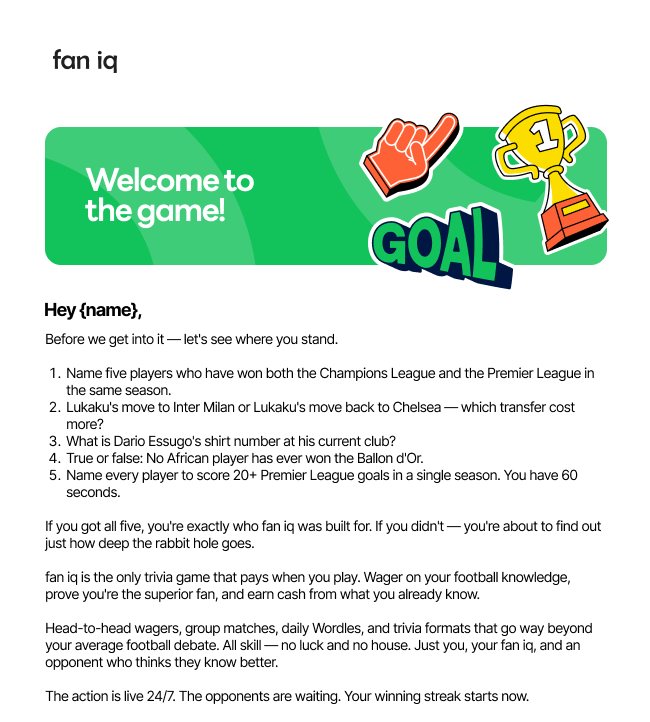
Email
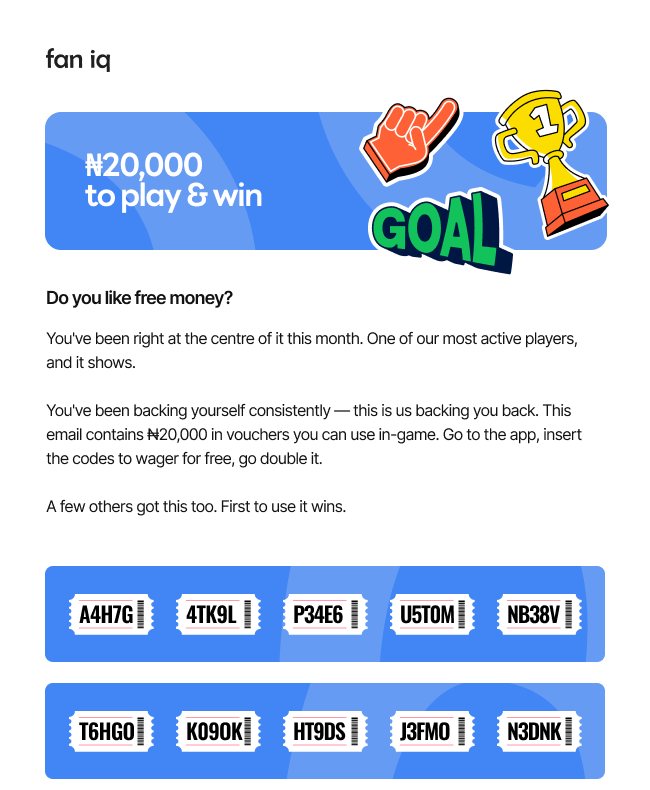
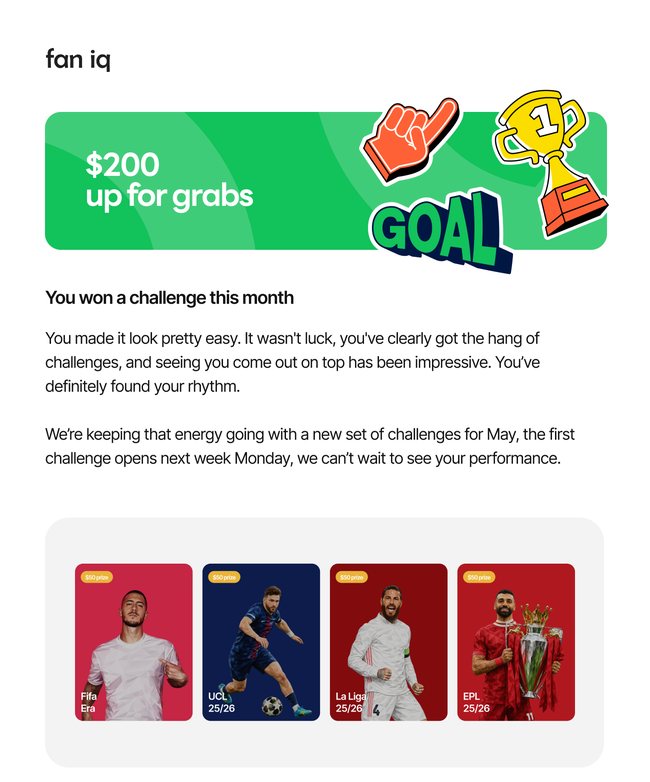
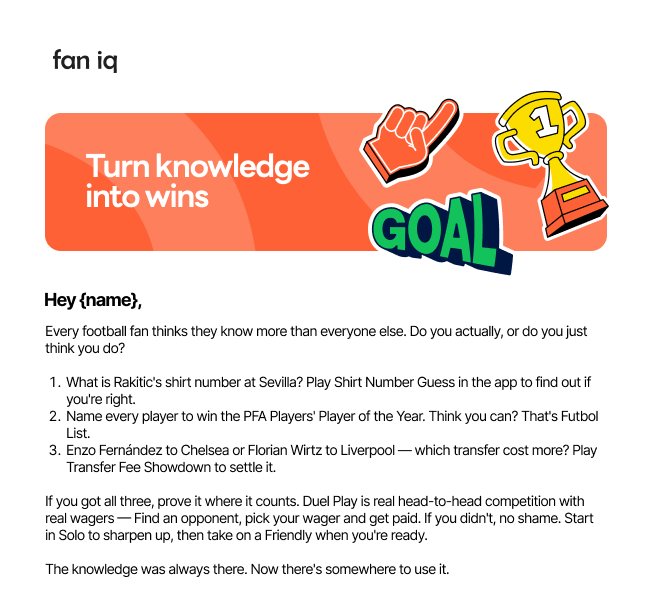
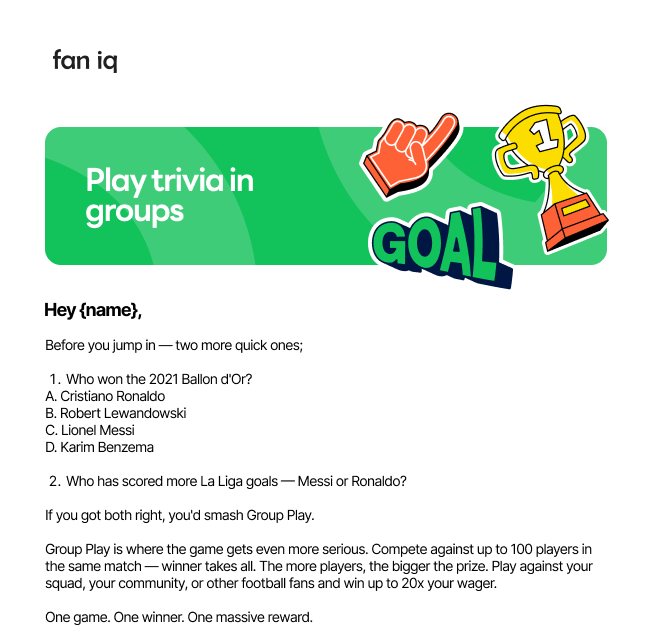
I wrote seventeen emails that follow where a player is: just joined, starting to drift, gone quiet, or gone. People who signed up but never played get their own set. Each email has one idea and one button, and the tone changes with the player. Welcoming at first, understanding when they slip, direct once they've gone. Several end on a voucher, free credit in a player's wallet that covers a wager, so coming back costs nothing.
New
Days 0–7
Day 0 welcome
Day 3 gameplay spotlight
Day 6 compete spotlight
No game yet: day 4, 5 and 7 nudges, ending on a voucher
At-risk
5–7 days away
Day 5: rivals are climbing the leaderboard
Day 7: voucher for players who had wagered
Dormant
10–14 days away
Day 10: credit waiting
Day 12: your club needs you
Day 14: thousands are playing right now
Churned
21–60 days away
Day 21: win-back credit
Day 30: a new challenge
Day 45: “Sure you want to go?”
Day 60: what’s new, then a quarterly list
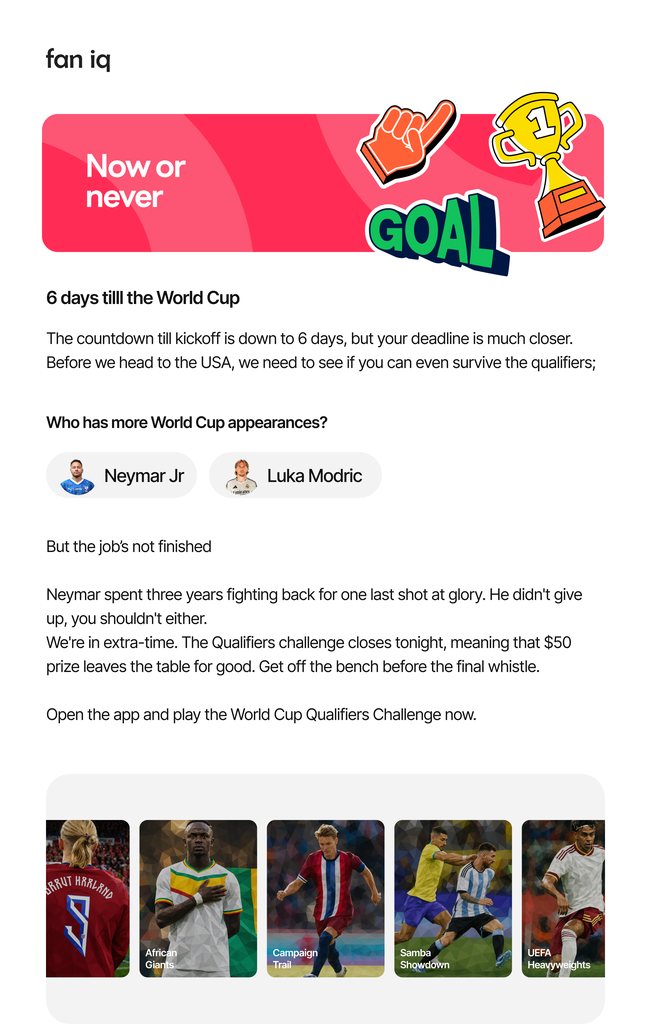
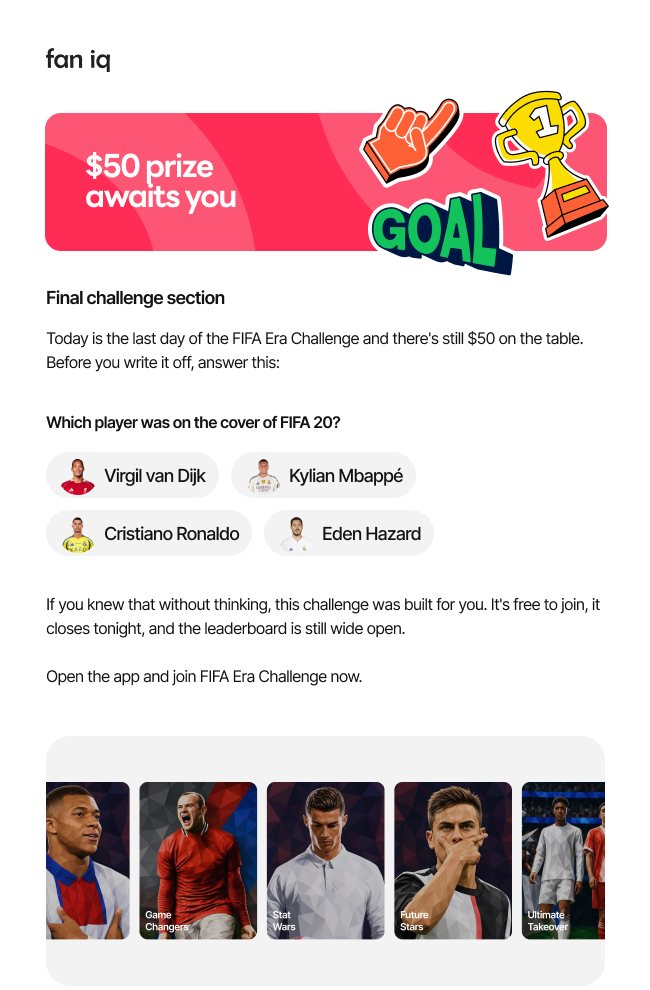
Alongside these there's a weekly club roundup and an email each time a new challenge section opens. They're mostly visuals with a few lines of copy, built for phones.
Lifecycle and campaign emails.
Push notifications
Push notifications are the most intrusive channel we have, so they got the strictest rules. Alerts from other players, like a friend request or a match invite, go out instantly and aren't capped, because it's one person talking to another. Everything we send ourselves is capped at two a day, and a lifecycle message takes one of those slots instead of adding to them. During a challenge there's a message for each new section, a halfway nudge and a last call. Players who are drifting get a lighter version, with just games and the daily news briefing, so volume doesn't push them out for good.
How the copy was written
For challenge notifications, the heading hints at the theme without giving it away, and the body adds what the heading leaves out. Last calls lead with where you stand on the leaderboard, not just the deadline.
Lifecycle pushes
As a player drifts, the tone changes. Welcoming at first, then understanding, then direct.
fan iqnow
Your debut is waiting.One Solo game. No stakes. Find out where you stand.
New playerDay 1
fan iqnow
Still on the bench? 🪑One question. That's all it takes.
New playerDay 2
fan iqnow
Seven days and no debut.Your first match is still here. Jump in.
New playerDay 7
fan iqnow
You're on the team now.Come back tomorrow. Keep the streak alive.
ActivatedFirst game
fan iqnow
It's been a minute. 👀Everyone's playing. You're not. Easy fix.
At-risk3 days away
fan iqnow
The game hasn't stopped. ⏰Thousands are playing right now. Tap to get back in.
Dormant14 days away
Lifecycle push copy, by phase.
The pushes that worked
The ones that did best leaned on memory, identity or a question the player could answer. Click rates below are against the average across all sends.
fan iqnow
Join the group match now to compete!
Group Play invite3.1×
fan iqnow
You spent hours on FIFA. Let's see how much you remember in the next challenge
Challenge launch · nostalgia hook2.8×
fan iqnow
Klopp's Liverpool redefined an era. Play today's section.
Themed section push2.7×
fan iqnow
Man Utd Challenge is halfway done. Are you in the top half?
Mid-challenge rank nudge2.4×
fan iqnow
24 hours left. ⏰
Last call1.9×
fan iqnow
$50 up for grabs in our new PL 25/26 Challenge. Play now
Challenge launch · prize1.8×
Multiples are relative to the average click rate across all sends from January to June 2026.
Win-back
Not every lapsed player got the same message. Players who had wagered were told their winnings were waiting, and casual players got a no-strings invite back. Both got a voucher with a short expiry and one reminder. If they stayed silent after that, they got a single last email and then moved to a quarterly list, so we stopped mailing people who had left.
Product changes
Messaging can only do so much. The moment a challenge ended, the app gave players nothing to look forward to, so I took the data to the product team and pushed for three changes.
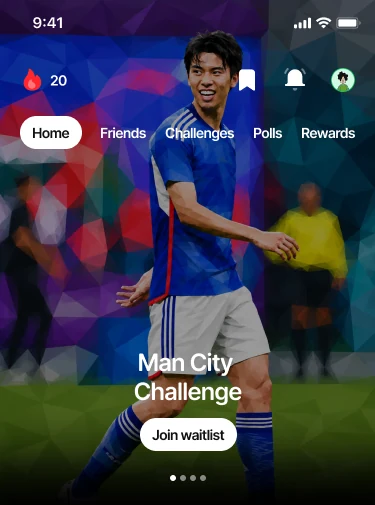
The next challenge shows before the current one ends, so players see what's coming while they're still engaged instead of landing on a dead screen.
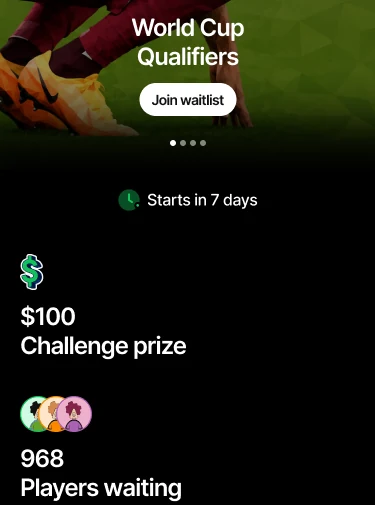
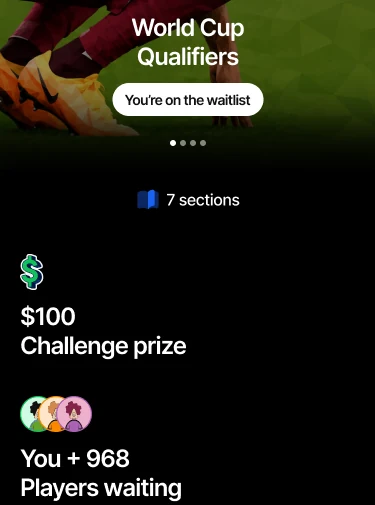
A waitlist for the next challenge. Join in one tap and get told the moment it opens. Every launch now starts with an audience already waiting.
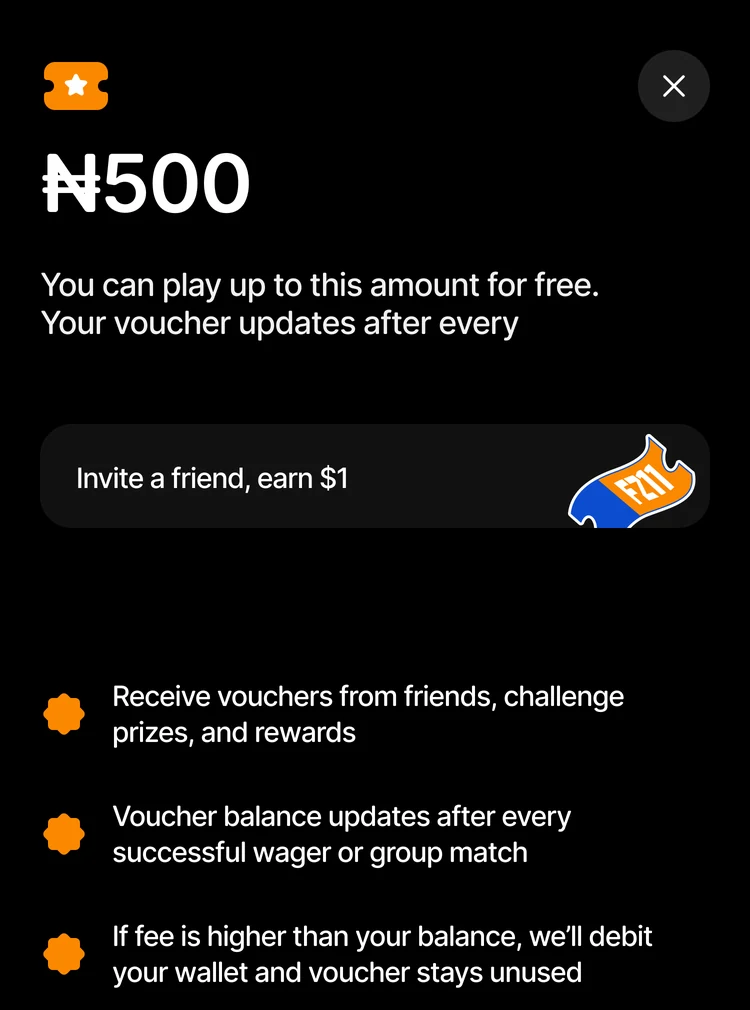
Monthly voucher giveaways, a regular reason to come back between challenges, and something real for the emails to point to.
Home screen: one-tap Join waitlist.Challenge page: countdown, prize and waitlist count.After joining: the count becomes "You + 968".Voucher screen: a free-play balance.
Waitlist and voucher screens. Swipe to see more.
Together they make a run of separate challenges feel more like a season. They also give players a reason to take further action in the game and to come back daily, which is what builds a habit.
The Result: June Without Campaigns
June was the test. No campaigns ran, so the system, vouchers included, had to hold players on its own. The vouchers went out by email and turned giveaways into play: 200 were issued, and they powered 180 wagers. About 504 monthly active users still played more than 1,100 game sessions across free and paid modes. The four challenges drew 181, 156, 138 and 174 players, an average of 162 and mostly the same people each time, so roughly a third of the monthly base showed up for every challenge.
504Monthly active users, with no campaigns running
1,100+Game sessions across free and paid modes
162Average players per challenge, across four challenges
180Wagers powered by 200 vouchers
What I Learnt (Key Takeaways)
The dead end after every challenge
Notifications couldn’t fix the moment a challenge ended and the app showed nothing next. The biggest shifts came from removing that dead end: the next challenge now shows before the current one closes, with a one-tap waitlist.
Fewer pushes, each tied to a moment
Every message spends a bit of a user's trust. By capping push notifications and tying every send to a real moment, like a ranking shift, a friend’s wager or a section opening, the messages that mattered actually got opened.
What the waitlist changed
When a challenge finished without a bridge to the next one, we spent the following month buying the same audience again. Waitlists, wallet vouchers and a visible next challenge meant each launch started with an audience already waiting.
The best growth comes from keeping the core audience you already have, not buying a new one for every campaign.
ScopeMarket Research · Brand Voice & Visual Design · Social Media Management · Community Growth · Campus Activations · Partnerships · Editorial Oversight
PeriodJan 2024 – Feb 2025
AT A GLANCE
0 → 745Student sign-ups in six months from launch
0 → 204Organic social followers built from scratch with zero paid ad spend
~69%Share of sign-ups driven via WhatsApp (512 of 745)
15%Landing page conversion rate from 5,000+ visits
~₦694Blended CAC across ₦517,000 in tracked campaign spend
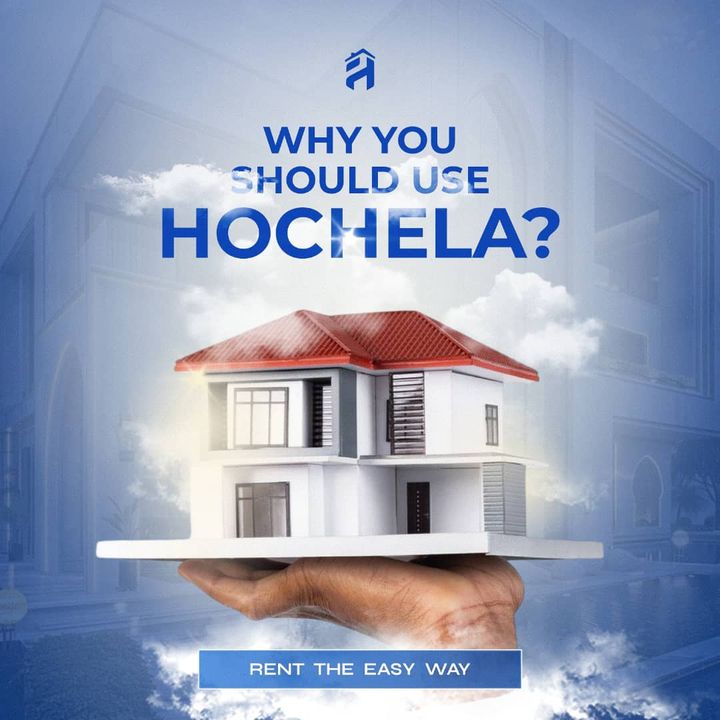
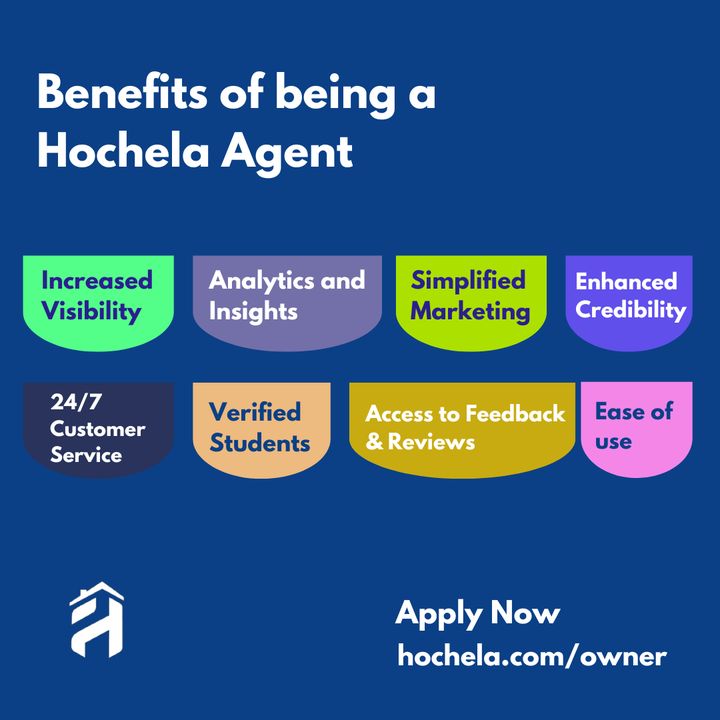
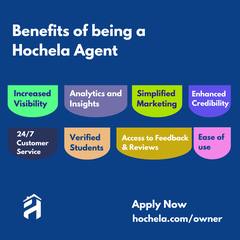
Student-facing creative: “Rent the easy way”.Agent-facing creative aimed at agents in Osun.Pidgin creative for agents and students.
Launch creative for both sides of the marketplace. I defined the student-first tone of voice and designed all visual assets across the rollout.
The Challenge: Cold-Starting a Marketplace in an Offline Market
Hochela was a digital marketplace built to fix off-campus student housing in Nigeria. Traditionally, university students looking for annual leases had to navigate predatory third-party middlemen—paying ₦70,000 to ₦100,000 in combined agency and inspection fees on the high end just to view and secure a room. Hochela digitized the entire flow: agents and landlords listed verified properties with upfront pricing, and students browsed and leased directly from their phones without physical middlemen or inspection fees.
When I joined as Marketing Associate, the platform was nearly finished, but nothing else existed: no users, no marketing plan, a shoestring budget, and a brand-new name. The company chose Osun State (OAU and UNIOSUN campuses) as our launchpad because there was no direct digital competitor.
Reporting to the CEO alongside a lean team (a COO, two developers, an SEO writer, a junior marketing lead, and an in-house agent), I owned the market research, brand voice, end-to-end visual design, social media management, content production, channel strategy, campus activations, and partnerships.
Step 1: Field Research & Dual-Sided Positioning
Before launching a single campaign, I spent my first month interviewing both sides of the market to understand what was actually broken:
The Student Reality: Students were exhausted by opaque pricing and losing up to ₦100,000 to agent and inspection fees before even moving in. They didn’t need a flashy tech pitch—they just needed a trustworthy, convenient way to rent.
The Agent Reality: Busy agents had more enquiries than time to conduct physical viewings, so we positioned Hochela as “an agent to the agent”—a digital ad space and filter that brought multiple verified students to their listings at once, allowing them to close deals without endless in-person inspections.
Working within the brand color palette set by management, I designed every piece of launch media myself and established a distinct tone of voice built to resonate with Nigerian students. Instead of stiff corporate copy, we used peer-to-peer campus language and Pidgin to make our core promise—“Rent the easy way”—feel immediately familiar across all touchpoints.
Step 2: Building the Demand & Content Engine
Launching a product to an empty room wastes your only chance at a first impression. Instead, I built a multi-channel engine that warmed up the student market two months before the platform went live.
1. Owning & borrowing WhatsApp communities & social channels
Phase 1 — Build before launch: Two months pre-launch, we started Hochela as a student-focused WhatsApp TV and built our organic social media presence from absolute zero. I developed and executed our content calendars, producing all organic assets—from static graphics, infographics, and posters to short-form videos and property listing images. Through consistent, culturally resonant posting with zero paid social spend, we grew our pages organically to 204 engaged followers. While our owned WhatsApp list grew to a tight-knit 181 direct contacts, it gave us an active seed community on day one.
Phase 2 — Borrow existing reach: Because Osun students already lived on a handful of massive campus WhatsApp TVs, we spent ~₦200,000 over three months sponsoring placements across those channels, funneling high-intent traffic both to our platform and our own channel. In parallel, I ran a ₦147,000 Meta Ads test across Instagram and Facebook (generating 104 combined sign-ups: 56 on Instagram, 48 on Facebook) to benchmark paid social against grassroots WhatsApp promotion.
To keep students engaged between housing searches, I acted as the final editorial checkpoint across our content pipeline:
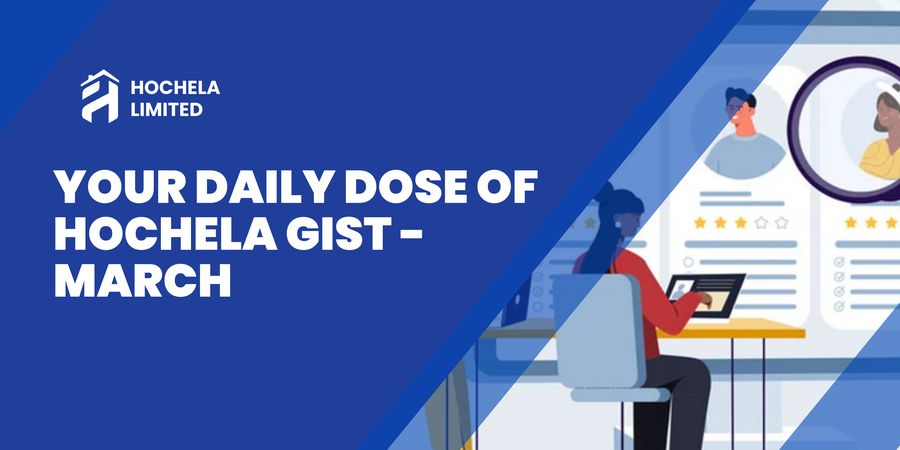
The “Hochela Gist” newsletter & visuals: A monthly newsletter and weekly infographics blending housing literacy with campus culture across our channels.
Local SEO pipeline: I oversaw the editorial output for our blog—publishing every two days—which steadily captured first-page Google visibility for Osun student housing search terms.
The daily “Hochela Gist” email header.Agent-side benefits graphic.Cultural moment content for the community.
Owned content, agent onboarding visuals, and community graphics—all designed in-house.
3. Campus activations & value-add partnerships
Phase 3 — Testing the campus: To test offline conversion, we recruited 10 student marketers directly from our WhatsApp community, and I briefed them on Hochela’s core message and designed the event banners, flyers, and custom merch (t-shirts) for the rollout. Across the OAU Forensic Science, Business Administration, and Estate Management student associations, we spent ~₦120,000 in event sponsorships to secure 20-minute speaking slots and on-site booths. Alongside the events, we ran two 2-hour physical flyer drives across campus—splitting the 10 marketers into two 5-person teams across separate days at ₦5,000 per person (₦50,000 total staffing cost).
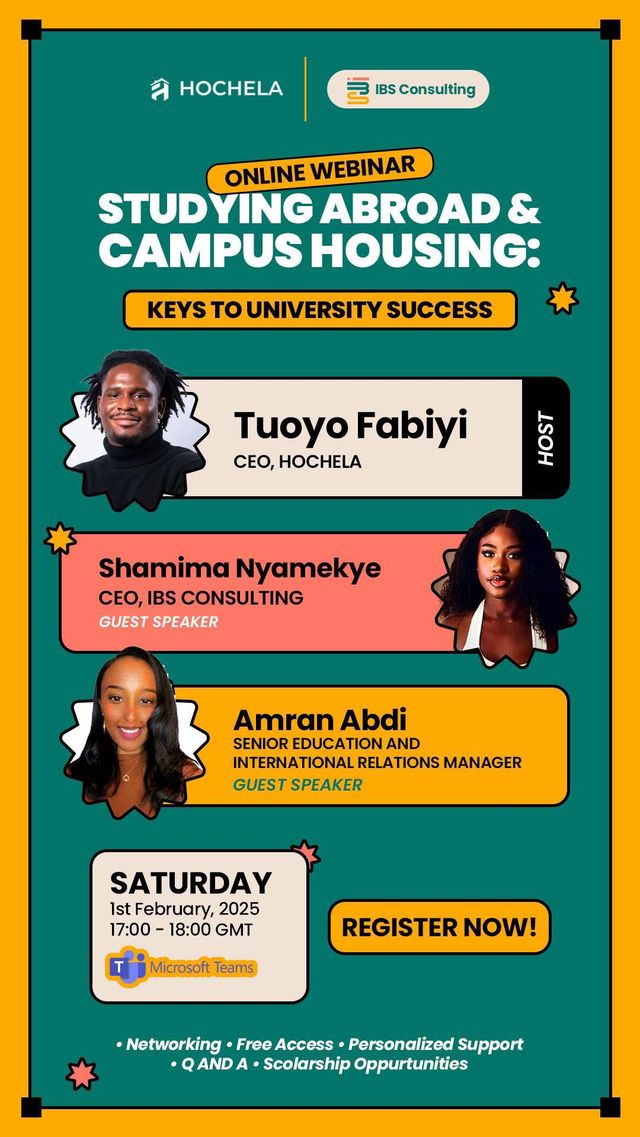
Phase 4 — Beyond housing (IBS Consulting partnership): Because our content and internship updates performed so well on social and WhatsApp, I knew our audience cared deeply about post-grad mobility. I partnered with study-abroad firm IBS Consulting to co-host the webinar “Studying Abroad & Campus Housing: Keys to University Success.” That single event drew 234 registrations, ~200 live attendees, and ~98 platform sign-ups.
Webinar poster with IBS Consulting, 1 February 2025.
The Results: Product-Market Fit on the Demand Side
Because the underlying pain point (₦70k–₦100k in middleman fees) was so acute, our landing page didn’t need a complicated gimmick—selling the straightforward convenience of the platform converted 5,000+ visits at 15%, generating 745 student sign-ups in six months on under ₦1 million in total spend (₦517,000 directly itemized across paid channels and activations).
Channel / Source
Sign-Ups
Share of Total
Tracked Spend
Est. Cost Per Sign-Up
Performance Takeaway
WhatsApp (Sponsored + Owned TV)
512
68.7%
₦200,000
~₦391
Dominant driver; 3.6x cheaper than Meta ads
Meta Ads (56 IG + 48 FB)
104
14.0%
₦147,000
~₦1,413
Good awareness, ~3.6x higher CAC than WhatsApp
IBS Consulting Webinar
~98
13.2%
—
—
High-trust conversion spike from co-branded partnership
Built 0–204 organic followers via calendars, posters, video & listing assets
The channel insight: WhatsApp delivered nearly 70% of all sign-ups at almost one-fourth the cost of Meta ads (~₦391 vs. ~₦1,413), whereas physical campus activations cost ~₦8,500 per sign-up—nearly 22x more than WhatsApp, even before factoring in banner and merch printing. Once that gap was clear, we cut offline activations and focused entirely on WhatsApp and partner webinars.
The Marketplace Reality: Why Supply Resisted
While student demand was immediate, a two-sided marketplace dies without supply. Alongside our in-house agent, we onboarded 6 agents and ~30 property listings—which meant hundreds of active students were competing for just 30 units, resulting in only 7 closed leases before Hochela wound down its Nigerian pilot in early 2025 to focus operations on the Canadian market.
Our pitch to agents—that Hochela would act as “an agent to the agent” and save them physical viewing time—ran into a hard economic reality:
Misaligned fee incentives: Many local agents realized they made more easy cash from inflated inspection and agency fees than from transparent, standard rent commissions.
Fear of disintermediation: Agents feared that once Hochela gained traction, landlords would bypass them entirely and list units directly on the platform to keep 100% of the profit.
What I’d Do Differently
Lock in landlord supply first (bypass middlemen): Depending on traditional agents to list properties voluntarily was the fatal flaw. If building this again, I would delay mass student acquisition and structure direct deals with property owners and hostel landlords first—using our 15% student conversion rate as leverage to guarantee occupancy.
Tighter attribution & faster channel experiments: While scaling WhatsApp and organic social channels worked, I would implement stricter UTM and referral tracking across our content calendars, SEO blog, and social distribution from day one to isolate exactly which creative assets drove the highest-intent sign-ups.
90Days planned, day by day, across 3 monthly themes
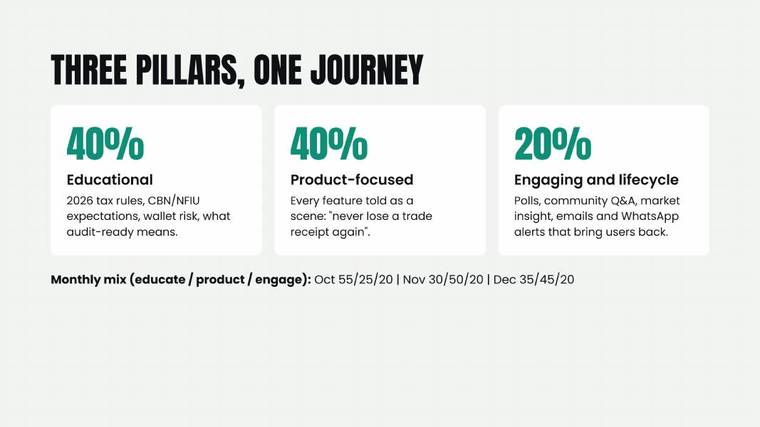
40/40/20Educational, product and community mix
5Behaviour-triggered lifecycle moments
11KPIs with a defined pass mark
The core idea: sell peace of mind.Three pillars, one journey, with the monthly mix shifting from education to product.
The Brief
I wanted to show how I would run content in fintech, so I built a full three-month plan for a crypto compliance platform (name withheld) that gives OTC desks and P2P traders audit-ready records, tax readiness and wallet checks. It covers themes, platforms, formats, and the balance between educational, engaging and product content, with every decision explained.
The Idea
The plan sells compliance as the thing that keeps a trader trading. The pitch is peace of mind: records and checks that run quietly in the background while deals close at WhatsApp speed. The three-month arc follows the buyer's emotions: fear of getting caught out, then proof it doesn't slow you down, then a daily habit. Each month gets its own theme: The Regulatory Awakening, The Speed of Compliance, and Habit and Trust.
Before We Post a Word
A two-week pre-content plan comes first. Listen to current users and traders about where tax and compliance hurt (lost receipts, bank questions, tax fear). Take the top issues to the product team and fix them first. Write the message bank, hooks and scripts in the traders' own words. Then stockpile two weeks of approved, link-tagged content with baselines captured, so launch day is not the first day of production.
Who We Talk To, and Where
OTC desk managers and P2P traders: X, WhatsApp, Telegram and YouTube Shorts. Content about speed, wallet safety and records inside the chats they already use.
Founders, fintech and compliance leads: LinkedIn, newsletter and webinars. Regulatory readiness, tax logic and audit infrastructure.
Active users: email and WhatsApp alerts. Habit, risk score updates and proof of time saved.
Building on What the Client Already Had
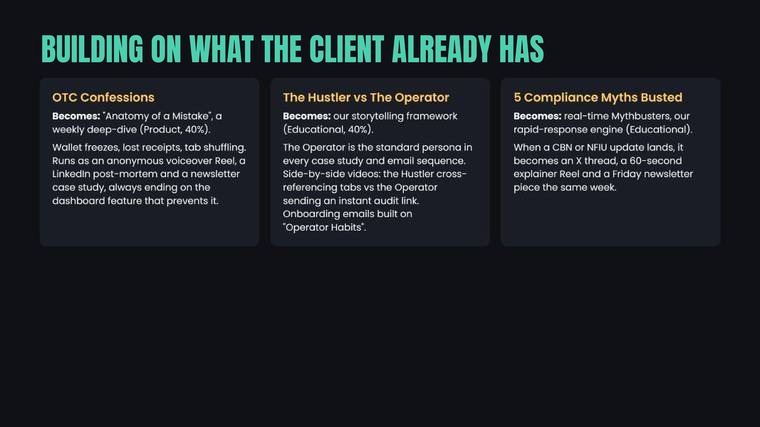
Rather than starting from a blank page, I turned their three existing content concepts into repeatable engines. OTC Confessions became "Anatomy of a Mistake", a weekly deep-dive that always ends on the product feature that prevents the mistake. The Hustler vs The Operator became the storytelling framework, with the Operator as the standard persona in every case study and email sequence. 5 Compliance Myths Busted became real-time Mythbusters, so a new CBN or NFIU update turns into an X thread, a 60-second explainer and a Friday newsletter piece in the same week.
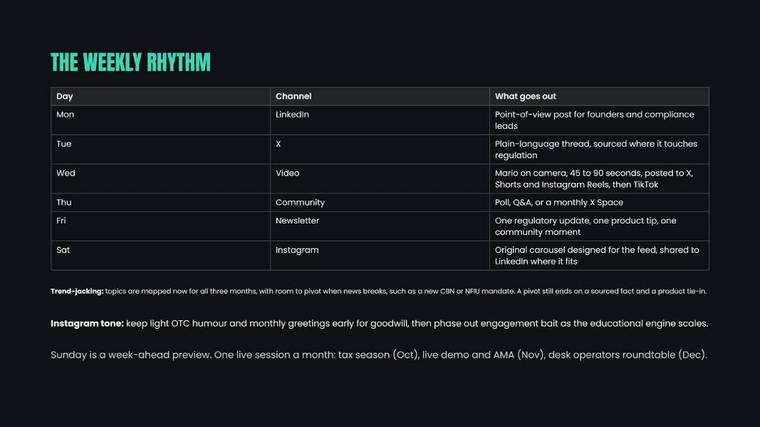
Three existing concepts, each turned into a weekly format.A fixed weekly rhythm: one channel, one job, six days a week.
One Core Asset, Many Formats
Every week follows the same rhythm: a LinkedIn point of view on Monday, a plain-language X thread on Tuesday, an on-camera video on Wednesday, a community poll or Q&A on Thursday, the newsletter on Friday and an original carousel on Saturday, with a monthly live session. Content is made once and cut many ways, with an AI-assisted workflow for scripting, visuals and captioning.
Guardrails are non-negotiable: every regulatory or tax claim is sourced and signed off, with no promises about tax outcomes, no invented testimonials and only anonymised data in reports.
If resources get tight, five things are protected first: the Wednesday video, Friday newsletter, Monday LinkedIn post, monthly live session and lifecycle messages.
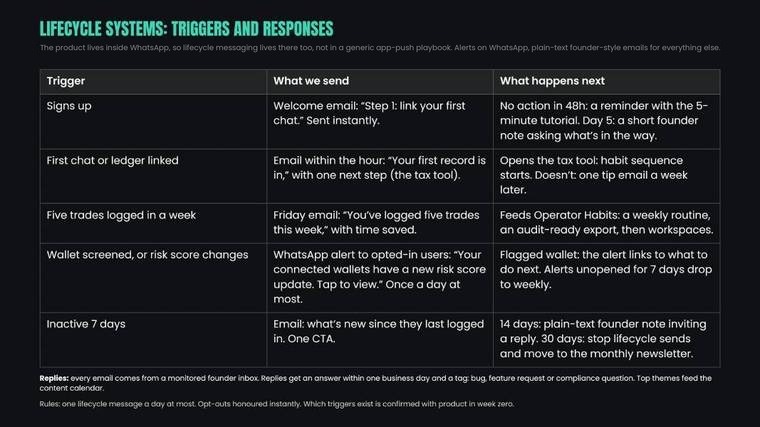
Lifecycle, Built for WhatsApp
The product lives inside WhatsApp, so lifecycle messaging lives there too, not in a generic app-push playbook. Alerts go out on WhatsApp and plain-text, founder-style emails handle the rest.
Five behaviour triggers drive it: sign-up, first chat linked, five trades logged in a week, a wallet risk score change, and seven days inactive.
The rules keep it respectful: one lifecycle message a day at most, opt-outs honoured instantly, and every reply answered within one business day and tagged (bug, feature request or compliance question) so the top themes feed the next content calendar.
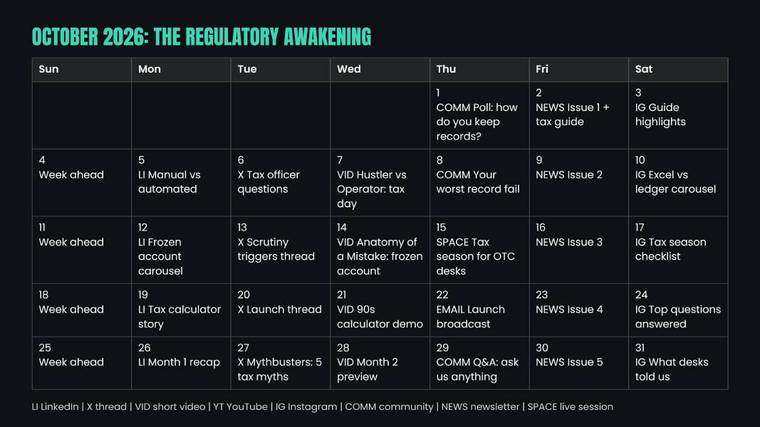
Triggers, what gets sent, and what happens next.October mapped day by day, from the record-keeping poll to the month-one recap.
How Success Is Measured
Eleven KPIs across reach, engagement, sign-ups, activation, retention and feature use, each with a monthly target. Sign-ups from tracked content links climb from 100 to 250 to 400 over the three months, and activation within seven days from 35% to 40% to 45%. The pass mark is at least 8 of 11 targets, with sign-ups and activation both among them. The targets are proposals for an early-stage account and reset after the week-one baseline.
What I'd Stand Behind
Fix the product before you market it. The pre-content listening sprint feeds the product team first, so the content never promises something users can't feel.
Systems beat one-off posts. A weekly rhythm, a persona framework and a rapid-response engine mean the calendar survives a busy week.
Credibility is the channel. In a regulated space, sourced claims and honest recaps do more for trust than clever hooks.
This is a strategy proposal. It has not been executed, and no performance results are claimed.
Building the video, animation, and design pipelines behind every campaign across 4 brands
RoleCreative Production Lead & Motion Designer
TypeVideo, Animation, AI & Design Production
Companyfan iq · Hochela · Omo Studios · DFRNT.ENT · Independent
ScopeVideo Editing · Cinematography · Color Grading · Motion Design · AI Workflows · Template Systems · Brand Consistency
StatusOngoing · 2025 – 2026
AT A GLANCE
100+Creative assets produced
60Short-form videos & animations
10Long-form videos
30+Scalable design templates
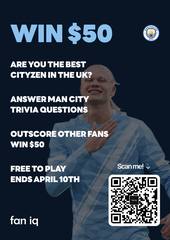
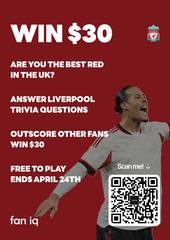
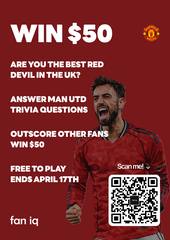
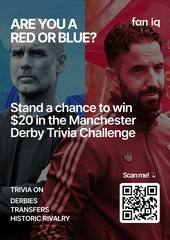
A selection of the graphics: ads, templates, flyers and brand work. Swipe or drag to browse, tap to enlarge.
How the system works
When operating in fast-moving startups or agency environments, treating every request as a one-off project makes creative production the primary bottleneck. Across every brand I’ve produced media for, my goal has been the same: build systems so assets are always ready to go.
Whether executing a Creative Director’s high-touch visual vision on set, building flexible motion ads from structured briefs, or deploying generative AI models to scale output, I work as if a larger team is right behind me. Every asset is built to be reused, and every design file or raw shoot is structured to feed the next ten pieces of content.
1. AI-augmented motion & performance ad engine (fan iq)
At fan iq, the demand for fresh sports content and paid acquisition assets is continuous. Working in a creative team of three, I built a flexible production system to output both organic social media content and high-converting performance ads.
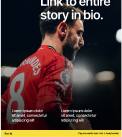
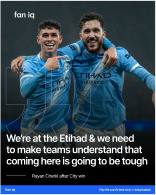
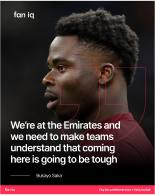
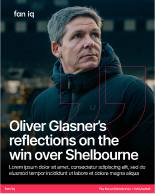
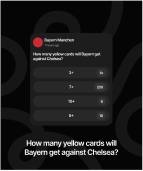
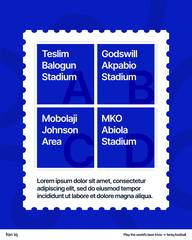
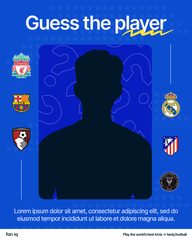
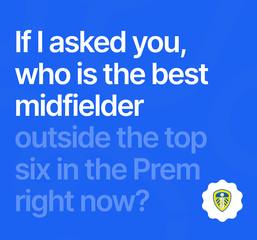
Social media content: daily football trivia formats, interactive polls, matchday reaction clips, player card graphic series, and feature launch videos designed to keep organic social channels active.
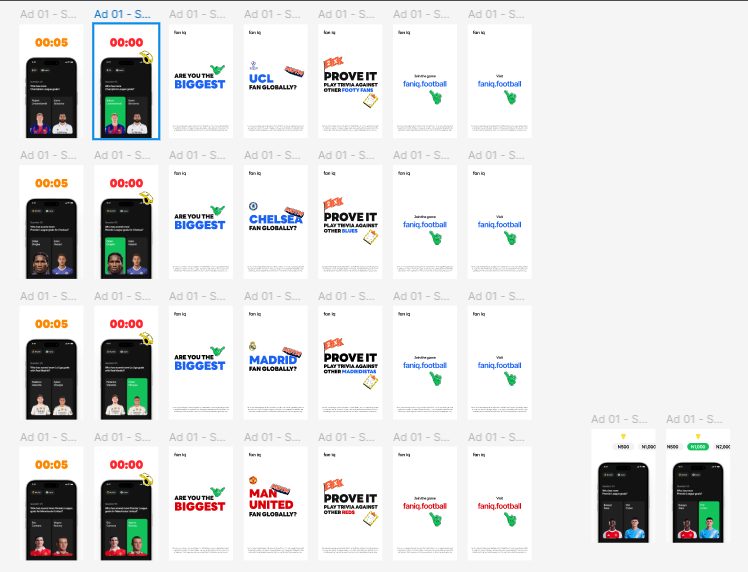
Flexible ad creative: dynamic video ads and modular visual hooks engineered for rapid ad testing, allowing the team to iterate on different football club variants, headline copy, and visual hooks without starting from scratch.
AI production stack: ElevenLabs for natural AI voiceovers on product explainers, ad hooks, and feature walkthroughs, alongside Google Flow for custom UGC-style avatars and animated characters for campaign launches.
The 3-step motion pipeline
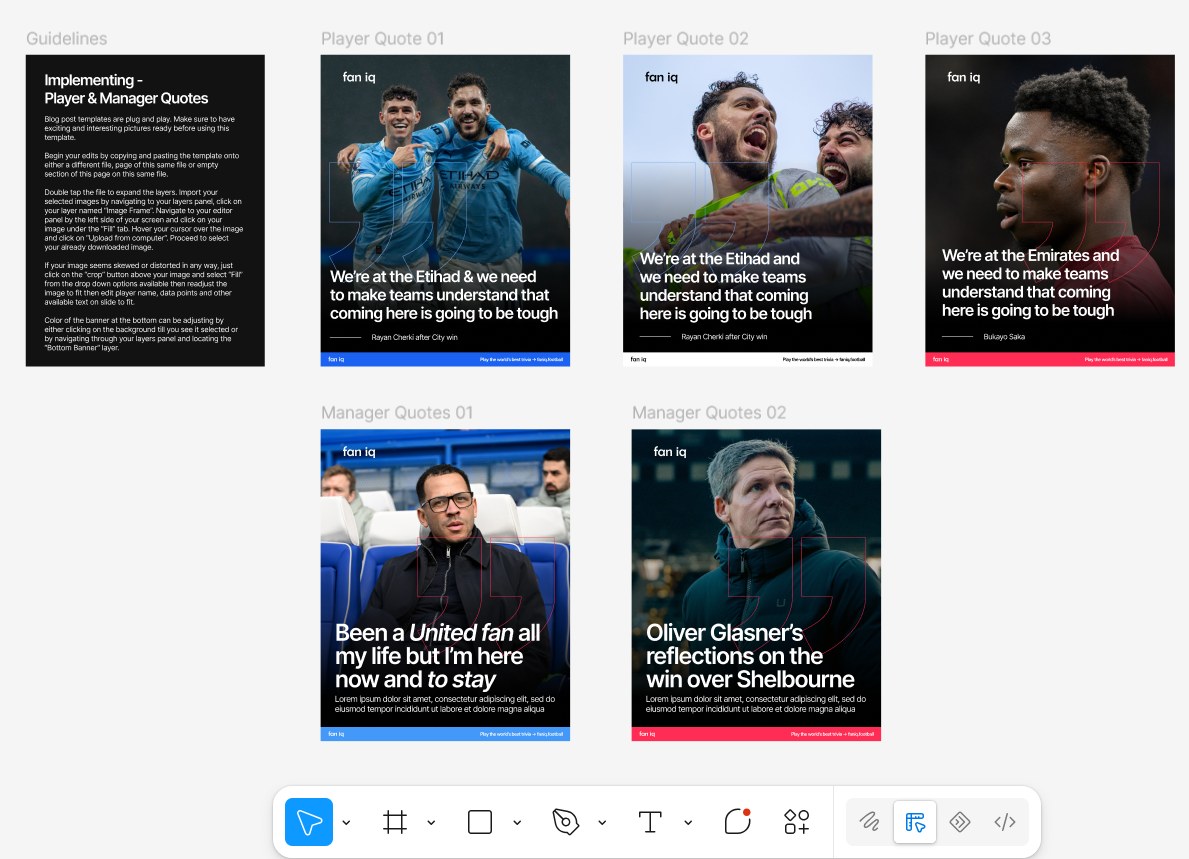
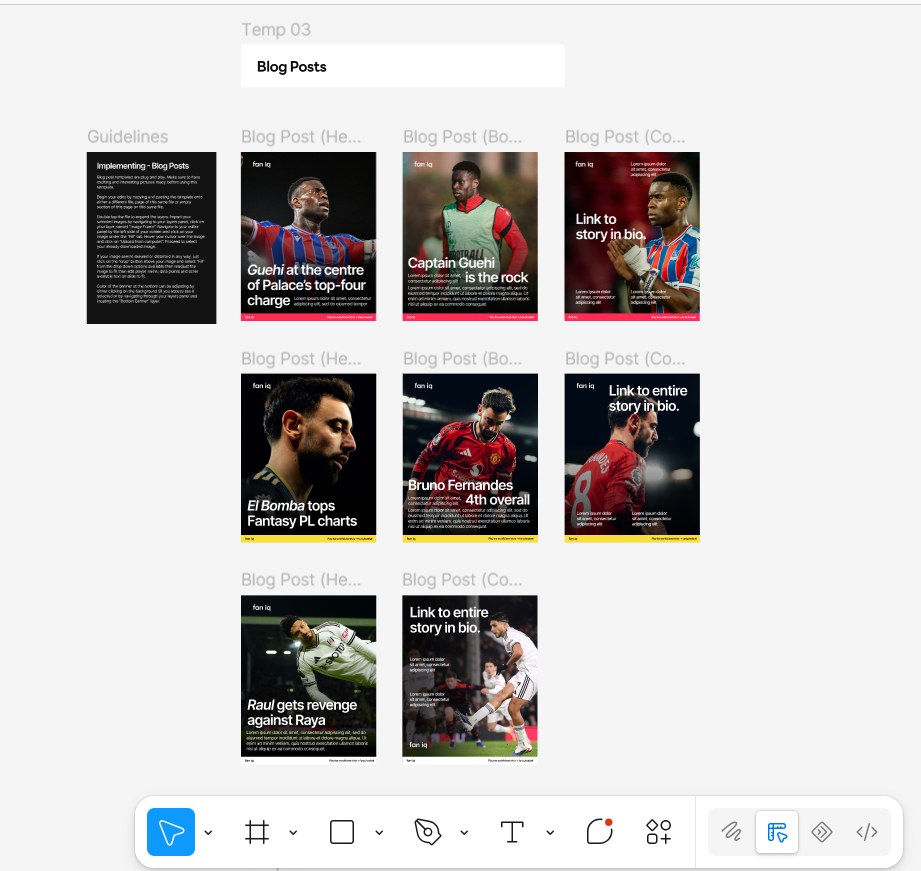
Design in Figma: layouts, typography, and brand colors are locked once at the source, with built-in on-page instructions for easy reuse.
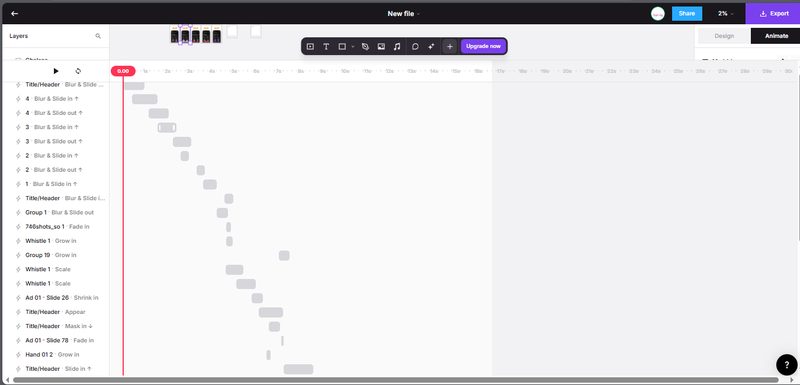
Animate in Jitter: frames move directly into Jitter layer by layer, keeping motion behavior smooth and on-brand.
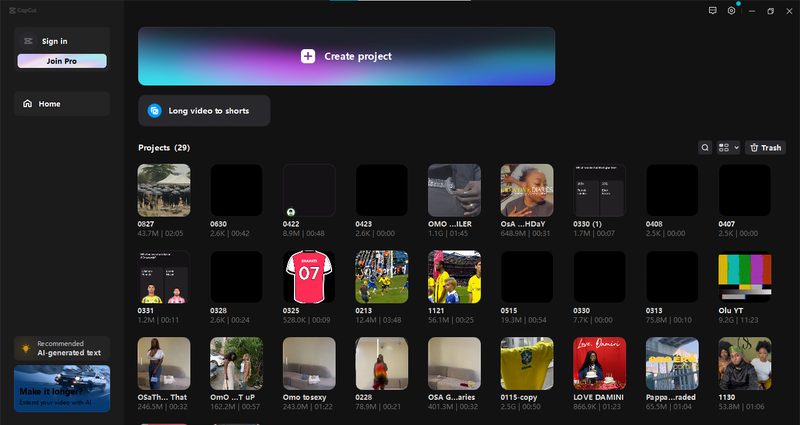
Finish in CapCut / Premiere Pro (where necessary): final cuts, dynamic captions, AI voiceover sync, sound design, and platform-specific exports happen here. Some pieces are finished directly in Jitter instead.
1. Design in Figma2. Animate in Jitter3. Finish in CapCutQuote templates: player and manager variants from one systemBlog post templates: header, body and conclusion cards
2. High-speed templates for everyday campaigns (Hochela)
Not every brand needs complex motion rigs; sometimes the priority is sheer turnaround speed across multiple departments.
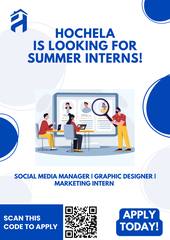
At Hochela, I adapted the same template-first principle using Canva and CapCut. Instead of heavy custom assets, I designed lightweight, locked-down visual systems that could be rapidly spun into agent recruitment drives, student messaging, seasonal greetings, and hiring posts, building the format once and scaling it across every campaign touchpoint.
3. Agency execution: set to post-production (Omo Studios & DFRNT.ENT)
A creative engine isn’t just for digital UI templates. It also dictates how you shoot, grade, and package agency media so post-production never stalls.
Omo Studios: working under Head Creative Director Osa Omo, I took complete ownership of technical execution, translating her high-level creative vision and storytelling into finished visual assets. I handled the full production chain: capturing stills and video on set, precision editing, and final color grading.
DFRNT.ENT: operating from client and internal campaign briefs, I led media design and production, creating the custom wordmark and event identity for the Bad Behaviour campaign, then editing high-energy promotional cuts in CapCut for cross-platform distribution.
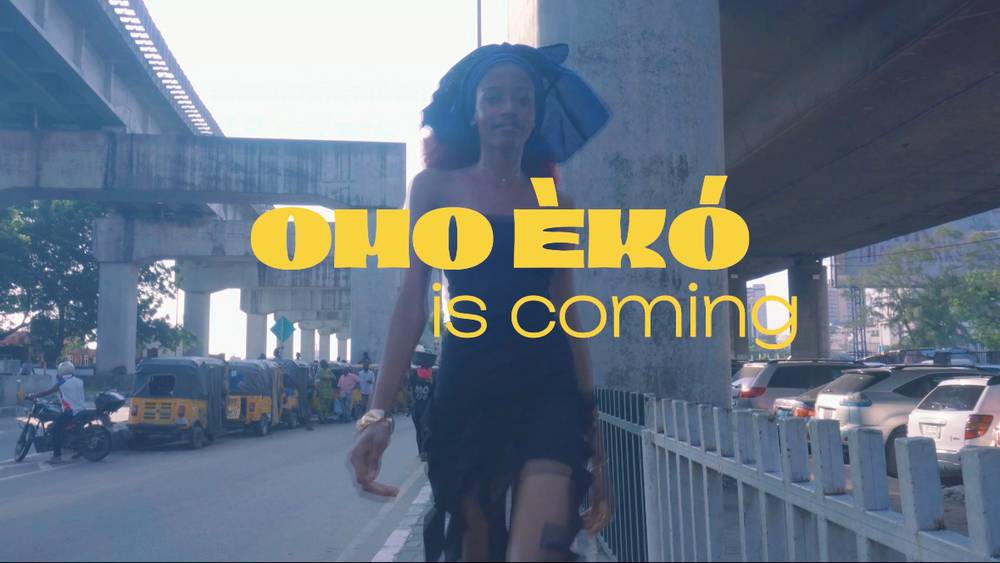
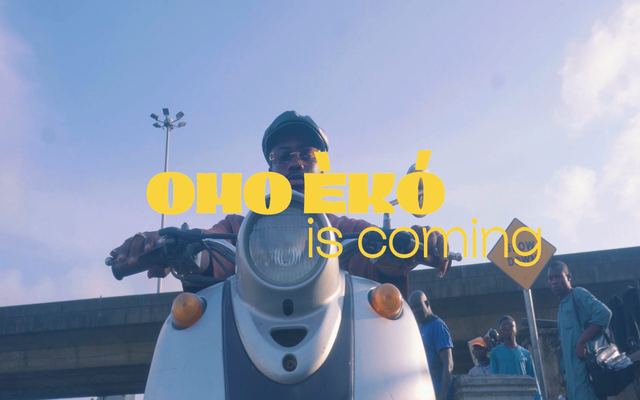
Omo Èkó: on-set captureOmo Èkó: on-set captureOmo Èkó: title treatmentOmo Èkó: on-set captureOmo Èkó: on-set captureStills photography: studio portrait
4. The freelance engine & software stack
Beyond agency and startup roles, I run a freelance post-production workflow delivering graphic design and video editing for diverse clients. I leverage LLMs like Claude and Gemini as workflow multipliers to refine script structures, generate motion concepts, and draft production briefs faster.
Video & motion: Adobe Premiere Pro, CapCut, Jitter
Design & systems: Figma, Adobe Illustrator, Canva
Generative AI & production: ElevenLabs (voice/audio), Google Flow, Higgsfield AI, Claude, Gemini
What changed
Instead of scrambling for media before a launch or waiting on slow turnaround times, the brands I worked with had a continuous, predictable supply of on-brand creative.
fan iq: creative turnaround dropped from 2 days to 8 hours, which allowed the team to test 11 ads across 3 campaigns. It also kept social and content scheduling steady, made A/B ad testing possible, and let the team swap ad creative quickly whenever a campaign underperformed.
Hochela: handling all content and creative in house, instead of outsourcing it, saved cost and supported the social media and community growth (204 organic followers, 745 sign-ups in six months).
DFRNT.ENT: the wordmark, event identity and promo cuts supported the Bad Behaviour campaign, which drew 700 guests.
By treating design, video, and AI as a single unified system, I have delivered 60 short-form videos and animations, 10 long-form videos, and 30+ reusable design templates, keeping both paid ad channels and organic campaigns stocked and ready to ship, for agencies and individuals alike.







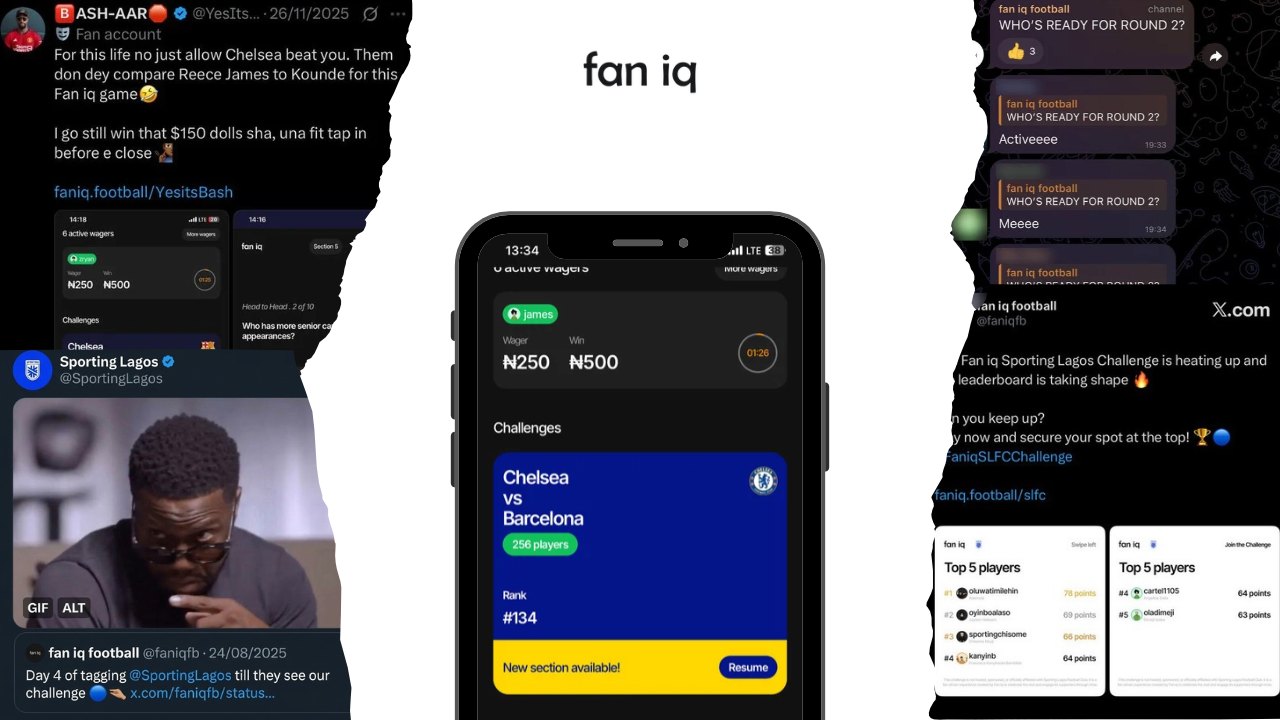 fan iq: Gaming acquisition funnel
Built a repeatable, event-driven acquisition system that took fan iq from a 200-user beta to 2,100+ users and ₦5.1M in wager volume.
Read case study →
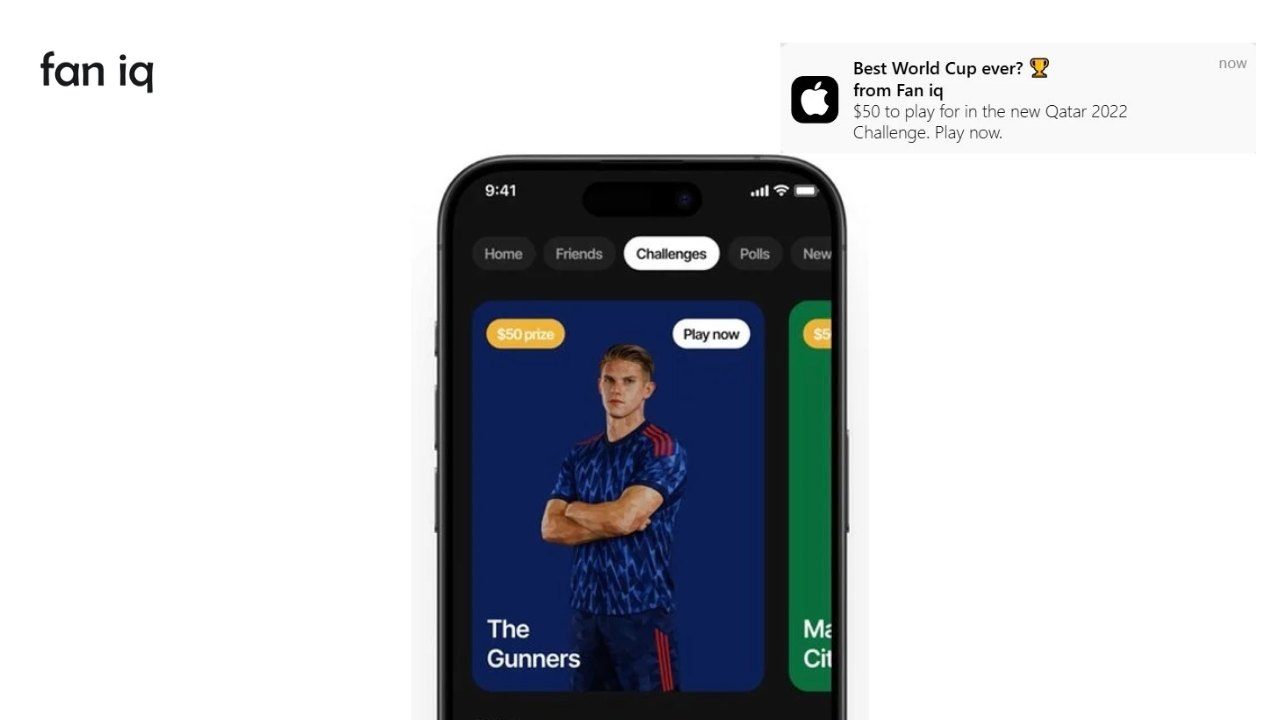 fan iq: The retention leak
Diagnosing a critical retention problem and solving it through lifecycle and product marketing.
Read case study →
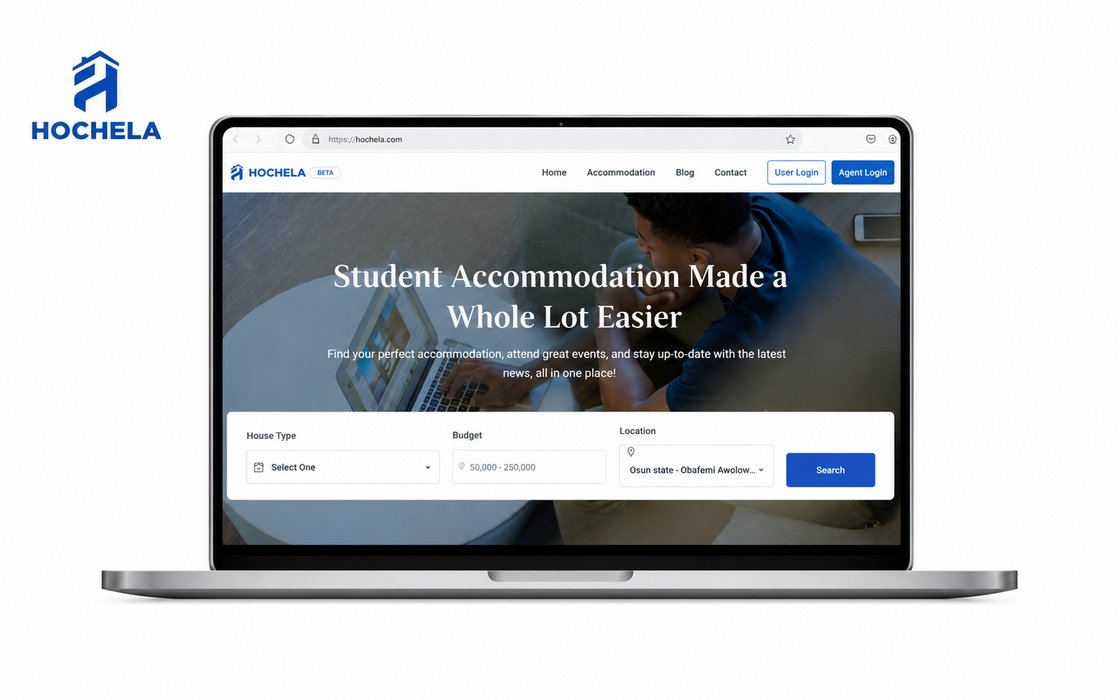 Hochela: Zero-to-One GTM
Building a student housing marketplace from scratch: 745 sign-ups in six months.
Read case study →
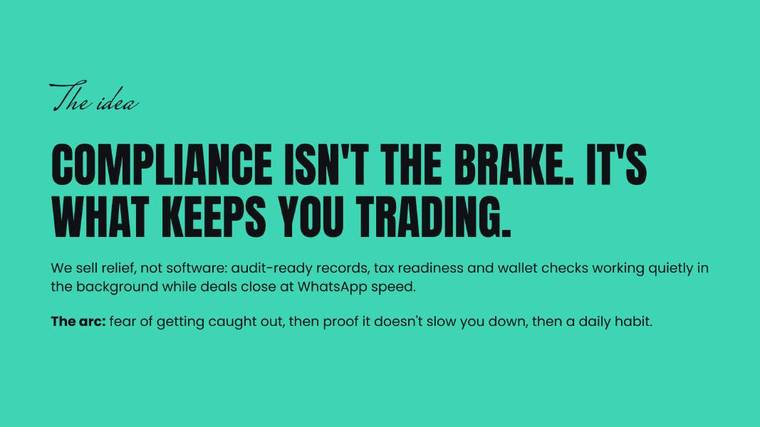 Fintech Content Strategy: 3-Month Plan
A 90-day content and lifecycle plan that sells compliance as speed to crypto OTC traders.
Read case study →
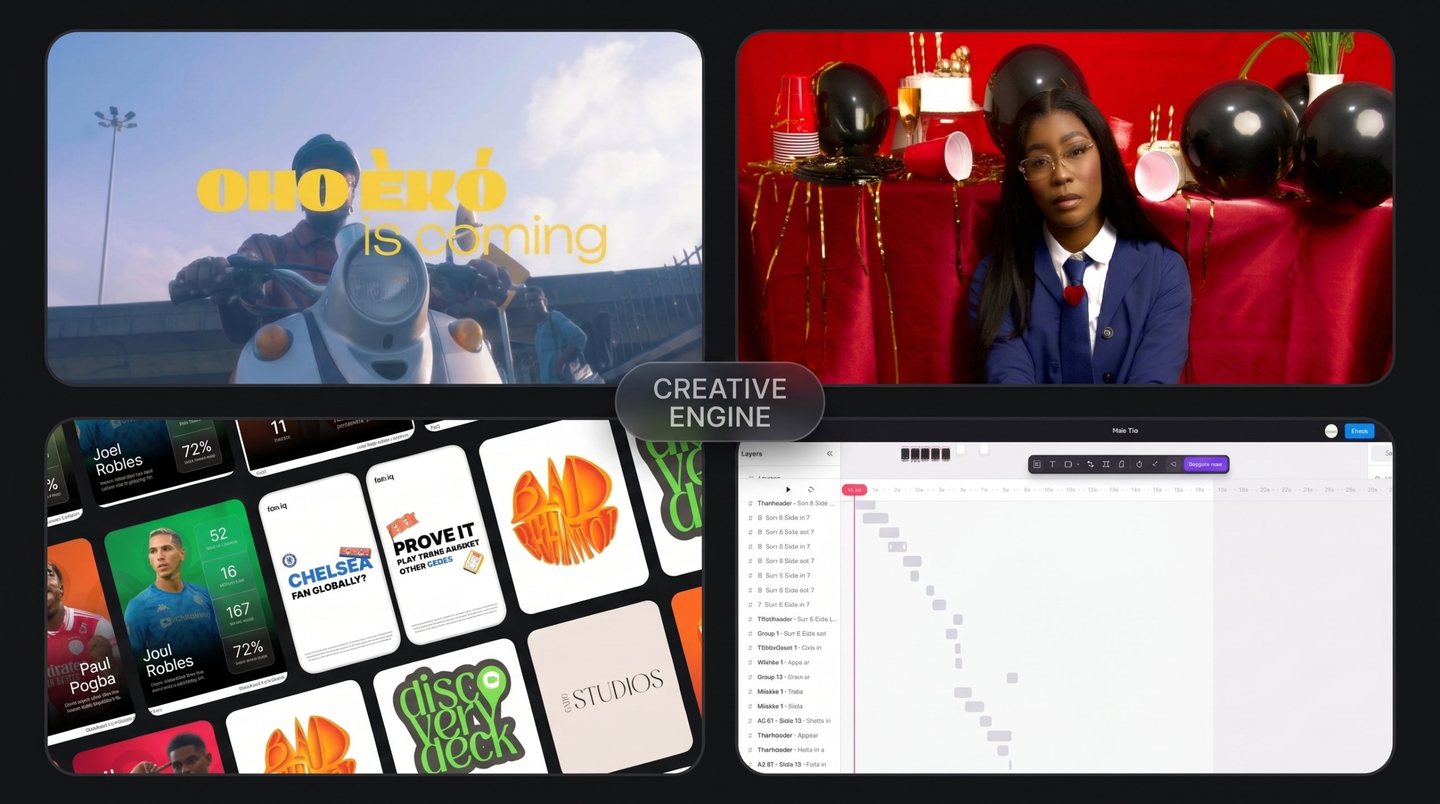 The 100+ Asset Creative Engine
Building the video, animation, and design pipelines behind every campaign.
Read case study →